Sunday, January 2, 2022

The negative bond/positive stock return of 2021 - will it continue?


There is a trade-off between stocks and bond returns. For the entire post-GFC period, the return correlation between these two has been negative, yet generally, both assets generate positive returns in any given year. The stock-bond asset allocation mix provides diversification with limited cost - the pain from holding bonds is limited.

While negative returns for both asset classes have been the exception (2015, 2018), there have been a few years when stock returns have been positive and bonds negative. The poor bond performance in 2013, 2015, 2018, and 2021 has a lot to do with the low yield for bonds in a zero-rate environment; however, except for 2021, these years were also low inflation periods.  


The question is what quadrant the stock bond mix will fall in 2022. A lot has to do with the expected macro environment. Make a call on the environment and you will likely know return performance. Similarly, make a call on return performance and you are implicitly making a call on the global economic environment. Given these quadrant probabilities and you have a reasonable and measurable framework for predictions. 


Quadrant I is the beautiful policy mix of liquidity and fiscal stimulus with and end of COVID and increases in global productivity. It is what we would like, but seems unlikely from current macro data. Quadrant II is the mild world status quo. COVID peaks in the winter and then retreats. Fed monetary policy follows a careful glide path and global fiscal policy provides downside protection albeit at lower levels. Stocks will do well, but bonds have headwinds from current high inflation levels and excessively low real rates. Quadrant III suggests policy mistakes from central banks - either tightening too fast or not fast enough. Quadrant IV is slower growth from continued COVID, limited fiscal response but continued dovish monetary policy and elevated inflation albeit without the extreme disruptions. 

These are simple sketches on possible environment but using the quadrants as a map for return performance is a simple way to address the return environment potential.

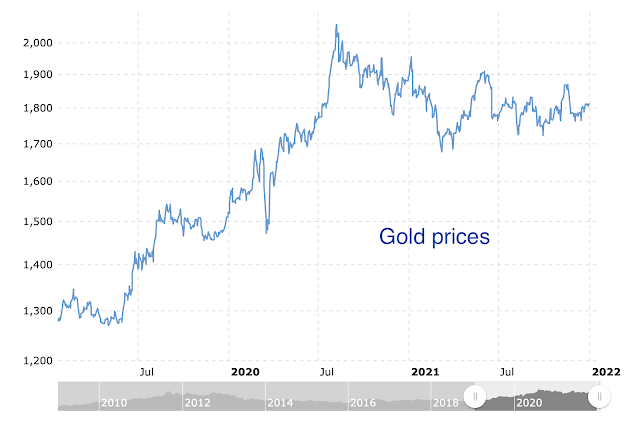
Gold, oh so old school - no interest in the precious metal


Gold has the interesting property of projection - it projects the hopes and desires of investors at a specific time. It can be an inflation hedge; then again it may not. It can be a hedge against uncertainty and geopolitical risk; then again it may not. It can respond to negative real rates, but now it is not the case. Gold should have been one of the great hedge investments for a pandemic and for a period it was until the end of summer 2020. Since then, it has been sinkhole for those fearing inflation and uncertainty. 

Despite higher inflation, the dollar has still been attractive. Despite volatility, crypto has been an asset class of inflation hedge interest. Despite low real rates, fixed income has still seen capital flows. For equities, the allure of technology has outshined gold. Gold does not have a compelling fundamental story. Hence, the current rangebound behavior. 

Can the gold story change? Of course, investors will project again their views on this metal, but there is no clarity on when or how this will occur.


Saturday, January 1, 2022

The big systemic risk - the need for stability and order


Government institutions fail when they cannot clearly communicate the realities that surround them. These institutions fail when they do not realize that in a real politic environment - there is always a play for power and a focus on self-interest. Government institutions fail when they don't provide stability and order both for those being governed and across institutions. These institutional failures are the real geopolitical systemic risk which should be the concern for investors. Tail risk events are often the result of institutional failure not the cause.

Systemic risk usually focuses on connectivity, technical details, and specific market failures and not broad failure of governing institutions.  Yet, the stability of the global order provides an environment for other more micro issues to take center stage for investor concerns - which is a good thing. When the global order is disrupted, there will be less investment and.  a flight to safety because the animal spirits of optimism are curtailed. 

Perhaps not so hidden in the pandemic is a turning away from experts and government institutions. Whether on the local, national, or international level, the lack of confidence in the current order will have an impact on financial investments. 

How can rising systemic risk be the case when we just had equity returns (SPY) of close to 27 percent for the year? Fiscal and monetary largess with pent-up demand was able to mask declining confidence, but globally there is less confidence in governments being able to articulate and address crises. The institutional glue that will bind behavior in a crisis has weakened which increases systemic risk. The failure of order at the local level will then play-out across countries. 

Unfortunately, this cannot be easily measured or isolated through some quant model. This is the essence concerning animal spirits and investment confidence. There is no easy measurement of optimism in the face of uncertainty. For Keynes in the 1930's, it was the role of government to prod aggregate demand and get confidence rising. However, if there is less confidence in potential solution providers, the threat of systemic failure increases. Yes, while this is pessimistic, discussing the systemic risk framework is critical for any 2022 predictions. 


Long-run commodity prices - it is all about cycles


Inflation is high relative to past few decades, but there will be mean reversion and many commodities which have risen significantly will revert to the mean. While many think of commodities as an inflation hedge, it is important to review the long-term cyclical nature of commodity prices. For many commodities, the increases over the last two years are market specific.

We can focus our attention on three commodities, crude oil, copper, and wheat. The three charts are in log scale. The speed of the oil increase was unprecedented, prices are well below the extremes even after the GFC, but these increases are related to returning demand and some production constraints. Copper prices are near all-time highs, but these levels are associated with the current demand for copper for the green revolution and the great build in China since 2000. Wheat prices are near highs from a decade ago based on weather shocks for key growing areas. 


Yes, inflation has caused prices to move higher, but much of the gains are market-specific. Making commodities an inflation trade will disappoint some investors.