Showing posts with label inflation. Show all posts

Sunday, February 15, 2026

The relative US - EM inflation story


If I asked the simple question, "Is EM inflation higher than US inflation?", most would say that EM inflation is higher. It has been, and always will be, yet the reality is different. US inflation has been higher than EM for almost 5 years. That is right. The Fed manages an inflation regime that is worse than that of the combined EM economies, and the gap is widening. Do you have to wonder why the dollar is falling? 

Tuesday, March 4, 2025

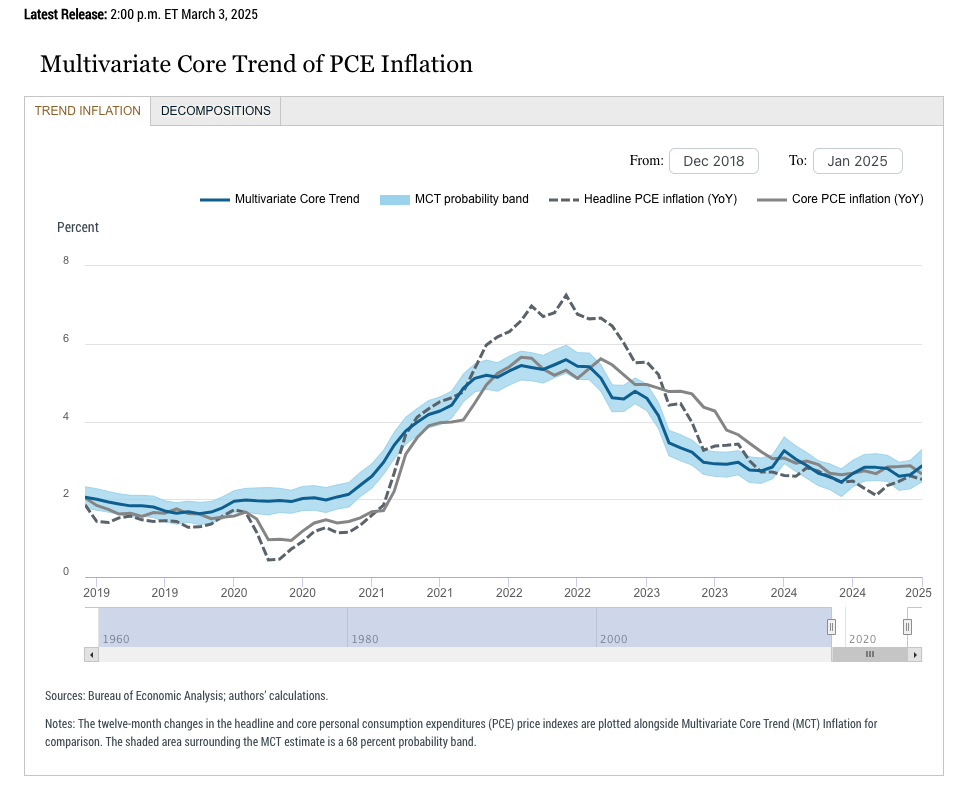
NYFed MCT suggests further persistence


The NYFed developed the multivariate Core Trend (MCT) model for PCE inflation to look at the persistence or trend of inflation components in the PCE. It tracks the PCE closely and explains why the Fed believed that inflation would not be persistent during 2022. The MCT numbers did not suggest that the components would persist. The PCE moved back to the longer-term MCT, yet the current data tells a story that the Fed is not winning the war on inflation. Inflation seems to be stuck just below the 3% level. By this measure, we are unlikely to see the Fed come close to the 2% target.  

Tuesday, February 4, 2025

Inflation perceptions - seems like consumer know better than the Fed


The Fed seems to view that it has turned the corner on inflation, yet we are still above target. The PCE inflation has been rising for the last three months and is above 2.5%. The CPI has also been rising for the last 3 months with the current number at 2.9%. The problem has not been solved, and we see to be in a sticky period of inflation above target. It appears as though September was an outlier, and the Fed made a mistake at cutting 50 bps in September. 

A recent survey looked at how consumer think about inflation and there seems to be strong opinions on the negative aspects of inflation. See "Why Do We Dislike Inflation?". Consumer clearly believe that it diminishes purchasing power and wages do not seem to match the increases in inflation. Hence, there must be costly adjustments to budgets and behavior especially for low-income groups. Inflation hurts financial assets and reduces savings and there is little trust that wages will keep up with the price changes. The anger about inflation is directed both at government and business with the government being over 3 times more likely where the anger is placed. Consumers also think that inflation hurst our international reputation, decreases political stability, and decreases social cohesion. This is some very interesting food for thought and suggests that the Fed and government in general should more closely listen to consumer views.


Monday, February 3, 2025

Inflation preferences - The big disconnect


There is a large disconnect between the inflation preferences of consumers and those of the central bank. The general population would like to see lower inflation - much lower than the 2% target, so it is no surprise that current inflation rate is not making consumers happy. Consumers have a preference for inflation at .2% which is lower than the magic 2% of central bankers. See the paper "Inflation Preferences"

Consumers focus on the fact that inflation reduces real wages and that it also reduces the purchasing power of their money balances. Both as good strong economic arguments. So if consumers have a strong preferences for lower inflation, why does the Fed persist with its view that 2% is the necessary target especially when consumers are not making judgments that are irrational? 

So, what should the Fed do given this strong consumer preferences for lower inflation? The authors realize that the Fed has two choices: one, adapt to the preferences of consumers and bring down the inflation target, or two, influence consumer preferences by educating them on the benefits of having higher inflation. 

This is a weird paper that seems to advocate that the Fed just needs to inform consumers that their life would be better if they suffered an erosion of their real wages and purchasing power because it would make the Fed job easier to reach their dual mandate of controlled inflation and full employment. Consumers just need to be educated on why the consistent pain in losing purchasing power is better than higher unemployment. I want to see Chairman Powell talk to the America people and tell them it is necessary for them to accept the Fed preferences over their own view and experience.

Friday, November 22, 2024

"Inflation is a social phenomenon" - Not quite


"Inflation is a social phenomenon," Powell said. "If people believe that inflation will be higher, then it probably will be. And if they believe that inflation will come down, then people who make and take prices and wages, they will make sure that it does come down. So, it's absolutely critical that we be credible."

- Powell press conference 


Should we give him the benefit of the doubt or just call out the craziness of this comment. Of course, inflation is effected by expectations but where do those expectations come from? Perhaps the Fed itself as the the producer of money! 

You cannot just say that if you believe something, it will happen. Are expectations always rational? No. is a component of inflation expectations backward looking? Yes. However, if you are the head of the Fed, you have to take responsibility for your actions.  

Tuesday, October 15, 2024

Inflaton expectations - it is about the things you buy all of the time


Inflation has been the number one economic issue for both the Fed and consumers, yet many policymakers have focused on the inflation of the last few years as a supply shock from the pandemic that was abnormal. Inflation is returning to normal levels; however, the inflation of the last few years was anything but normal. There has been a focus on core inflation, but the headline and anti-core is what may drive expectations. 

The first chart shows what has been called anti-core inflation. This is the inflation associated with food and fuel costs. This is the inflation that consumers face every time they go to the store. Anti-core inflation was not just high but extraordinary. The spike hit 40% which was just below the highs in Great Inflation. Headline CPI was the highest in over 40 years which has driven expected inflation highs for the next five-year period. Given the experience of the last three years, inflation expectations will not just return to 2%. The Fed has a consumer expectation problem and lowering rates at this time will not solve this problem. 

Friday, August 9, 2024

Campbell's law, Fed Policy, and 2% inflation


Campbell's LawThe more any quantitative social indicator is used for social decision-making, the more subject it will be to corruption pressures and the more apt it will be to distort and corrupt the social processes it is intended to monitor 

Jerry Muller's corollary to Campbell's Law, "Anything that can be measured and rewarded will be gamed."

Goodhart's Law, "Any measure used for control is unreliable." or "When a measure becomes a target, it ceases to be a good measure."

Let's think about the 2% inflation target. Why do we need to have a 2% target? What makes it so special? How close do we have to get to 2% to say the Fed is successful? What happened to an average inflation rate of 2%? If we want to average to a 2%, then should the Fed push to something below 2%?

Can you have deflation and economic growth? Is there something like good deflation and bad deflation? 

It is becoming increasingly clear that the focus on some arbitrary target can lead to more economic problem. If we control price inflation, we may just allow for greater asset price inflation. The goal is not some inflation number but stable purchasing power and effective growth. This may mean that the Fed intervenes in markets to provide financial stability but that is a last resort and not a policy of denying loses. We should not be data driven but goal driven. Let's be clear on the goals and why they are relevant. 

Monday, July 22, 2024

Geopolitical risk is tied to inflation


Inflation has come down from highs, but prices are still higher than what was seen four years ago. The value of savings has been eroded and if you did not see your wages increase, your purchasing power has declined. In the paper "Geopolitical Shocks and Inflation", the author shows that there is a link between inflation and geopolitical risk and it has gotten stronger over the last two decades.  Geopolitical shocks lead to increases inflation.

The increase in geopolitical risk leads to a decrease in international trade and supply disruption which then is then related to higher public spending, public debt and increases in the money supply.  Geopolitical risk leads inflation which calls for policy responses that create second order effects. If there are supply shocks, there is higher inflation and a GDP drop. The type of policy response will impact the size of the inflation and GDP shock. 


The driver for some of the voting for political change may be associated with the increase in geopolitical risk and inflation. Geopolitical shocks impact inflation which then drives household sentiment.


Friday, June 28, 2024

CPI versus PCE indices - The confusion from differences


A comparison of inflation indices: the Consumer Price Index (CPI), which is produced by the Bureau of Labor Statistics (BLS); the Personal Consumption Expenditures (PCE) price index is prepared by the Bureau of Economic Analysis (BEA).


The PCE fell slightly this month, but it is hard to tell what this means for the CPI. There is correlation because both are driven by price changes, but the wiggles and differences in the short run are hard to forecast.


Differences in the indices:


1. Formula effects. The CPI and the PCE index are constructed from different index-number formulas. The CPI index is an average based on a Laspeyres formula, whereas the PCE index is based on a Fisher-Ideal formula.


2. Weight effects. The relative weights assigned to each of the CPI and PCE categories of items are based on different data sources. The relative weights used in the CPI are based primarily on the Consumer Expenditure Survey, a household survey conducted for the BLS by the Census Bureau. The relative weights used in the PCE index are derived from business surveys—for example, the Census Bureau’s annual and monthly retail trade surveys, the Service Annual Survey, and the Quarterly Services Survey.


3. Scope effects. The CPI measures the change in the out-of-pocket expenditures of all urban households and the PCE index measures the change in goods and services consumed by all households, and nonprofit institutions serving households. 


4. Other effects. A variety of remaining differences consisting of seasonal-adjustment differences, price differences, and residual differences must be taken into account for a complete understanding of the differences between the CPI and the PCE index. 


Thursday, June 13, 2024

Why do consumers think differently about inflation from central bankers?


from Daily Chartbook 

"Normal people have a different way of looking at inflation compared to economists/central bankers."

- Dario Perkins, TS Lombard


This is a great way of thinking about how different groups view inflation differently. Central bankers are interested in the current rate of inflation. For them, the past is the past. Nothing to solve there. Consumers are worried about the level of prices. The past is important. Their concern is about whether prices will fall to old levels. Of course, wages may have increased, but consumers are smart enough to know that if real wages don't increase, it does not matter. Consumers also care about the inflation of repeat purchases. These prices stick in their minds.

Tuesday, April 30, 2024

Inflation - yes there was a transitory shock but ...


The discussion on inflation can be heated on whether the blame is with the Fed or is this just a tempest in a teapot about the transitory problem. There is no doubt that the pandemic with supply chain dislocations was a strong contributor to inflation. 

Claudia Sahm is one of the leaders of the transitory story and her case is strong, yet it seems like the last mile problem of getting to 2% is hard, and the slowing of inflation is not the same as reversing the inflation of the past. Prices are still high and that means if wages have not kept up with inflation, buying power has been diminished.


The question is not whether the Fed must hold rates higher for longer to slow demand and get inflation down to 2% but for how long. Since the transitory problem lasted longer than expected, we can also say that the rate rise will have to last longer than expected. Fiscal policy with deficits at 7% at full employment is a contributor that has yet to be offset. The conclusion is that the movement to normalcy is just going to be longer, yet the fear is that another shock will take us higher and not push us to target. The value judgment is that the Fed under-estimated the inflation lag structure.

Friday, April 19, 2024

The big inflation mistake - the problem of a generation


The screen shot is from the always insightful substacks of Rudy Havenstein who always seem to have unique pulse on key investment and economic issues. I don't intend to get political but highlight issues that impact investing. The inflation shift was a regime change that has been impactful on all models and macro thinking. 

The quotes tell the story that policymakers completely missed the potential inflation problem both from a short-term and long-term perspective.  From a short-term perspective, they got it wrong with the transitory story. From a long-term perspective, they did not consider inflation a problem that impacts labor and consumer markets. 

Even with lower inflation, the price level is still high for many consumers. Prices are not going back to normal. "Beating" inflation from a policy perspective just slows it down. The purchasing power is gone, and the only hope is that wages will increase to make up for the purchasing power shortfall. At best, the hope is to stay even with the future and not make up for past shortfalls in purchasing power. 

Saturday, February 17, 2024

PPI up - pushes Fed rate cuts into future


Yes, we know that the PPPI is not the key inflation measure used by the Fed. The focus is always on PCE not CPI or PPI. Nevertheless, the PPI gives us insight on what may happen to other inflation numbers. The correlation is far from perfect, but increases in PPI will play through the economy especially for services since services is such a large part of the US economy.

The inflation fight is not over.  Prices can be sticky and a strong growth economy with low unemployment will place upward pressure on prices. There is little reason for the Fed to change current rtes given current data. Fed cuts are pushed into the future and market rate expectations will come closer to Fed SEP estimates. 

Wednesday, January 3, 2024

The Cantillon Effect - What is driving survey differences?


Why are so many consumers unhappy in the current economic environment? We can think about the Cantillon Effect, names after the 18th century French economist. If there is new money in the system that can create inflation, it may first impact the rich who can increase their wealth. There may not be a general rise in prices as usually taught, albeit all prices may be increasing, but there are relative price changes which will affect different households differently. Because inflation can be localized and can be gradual, different groups will respond and be impacted by a shock to money that can lead to inflation. For example, increases food prices will have less impact on rich households because food is a smaller portion of their consumption basket.

Consumers who do not have wealth or do not have the knowledge or the capability to exploit increases in money may not be able to adjust or adapt to higher inflation pressures created from those who were able to exploit greater money earlier. These poorer households will be more impacted by the increase in goods without the ability to exploit the money increases. 

Hence, there is a distributional effect from inflation that is often not avoided in the inflation discussion. The inflation shock over the last two years has had a disproportional effect on lower income household who are not able to generate a wealth effect or are not able to take advantage of a monetary shock. 

The wealthy are feeling good about the economy. Poorer households who are unable to protect themselves from inflation may have a different view. 

Sunday, December 17, 2023

The destruction in purchasing power drives negative sentiment


“You never regain the purchasing power you have lost to inflation. There’s no such thing as deflation in modern monetary life…The important thing is the loss of purchasing power…that is not going to be recaptured, and that’s I think, the political significance of this number.” - Jim Grant   

The core problem with inflation in a modern era is the fact that no deflation will occur. What you lost in purchasing power will not come back. Even if your wages increase, your savings will not be able to buy the same basket as two years ago.


Saturday, October 7, 2023

Inflation debasement more than economic - political


"There is no subtler, no surer means of overturning the existing basis of society than to debauch the currency." - Keynes 1919 

We must think about inflation beyond the numbers and the impact on Fed policy and asset prices. There is a political component.

You can frame this debasement comment in two directions, a decline in the value of the currency or a decline in the value of domestic purchasing power. Inflation debases your purchasing power - for the same bundle of cash will get less goods. The debasement of the currency is a relative price issue. The dollar can still gain in value versus another currency, a relative gain. Currently, we are not seeing a decline in the value of the dollar but a significant decline in domestic purchasing power. 

Society is destroyed through the growing gap between low- and high-income households. The wealthy have a greater ability to protect against inflation while lower income households are not able to grow wealth and are likely to have more constraints on wage increases. Their marginal propensity to consume is higher. There is not slack in their budgets for higher real prices. If there is no chance for economic growth, thinking is focused in how to get more from others, a redistribution. Politics allow for redistribution especially with the economic majority attempting to take from the minority, those who have wealth. We must accept that politics will be driven by inflation shocks.

Monday, October 2, 2023

Inflation harm - the relativist and absolutist


Inflation is coming down. The Fed tightening is working. The consumers are saved. We are returning to normal. You have heard the arguments but that is based view that does not account for the true ravages of inflation. 

Yes, the rate of inflation is coming down but that does not mean that the basket of goods bought at the grocery store will fall. The cost of goods is not getting cheaper. It just means the rise in prices have slowed. If you have not seen your wages go up with the rate of inflation, your purchasing power has fallen. Your savings will not be able to buy the same basket of goods that you were able to purchase a year ago. 

How can we say that the world is better just because the rate has slowed. Wealth especially for those who have less to begin with has been destroyed. Your house may have increased in value but that is not a liquid asset which can be used to purchase goods today. 

The inflation relativist who may be look at the rate inflation may be happy, but the consumer purchaser who is an absolutist may not feel so good. If the price increases of used cars have fallen, that is great, but if the price of those cars have increased over the last few years, there is no bargain for consumers. Used cars have increased 50% over the last three years and new cars have increased by almost 30% while income has only increased 13%. Tell me why this would feel good for consumers. Assume use car prices fell 20%; the consumer will still be behind. 

Hard to say we have whipped inflation if real purchasing power has still declined. 

Sunday, July 30, 2023

Inflation transitory story - it just took longer


The Fed's preferred measure of inflation, the PCE price deflator, continues to move lower with both the headline and ex food and energy indices showing a strong downtrend. The transitory story seems to make sense albeit it took longer than expected. The supply shock disruptions from the pandemic are done. The demand shock from the excessive stimulus also looks to be done. 

The decline in inflation was achieved to some degree in spite of the Fed increasing rates. It is not clear, at this time, that financial conditions have been tightened to offset demand and create a recession. Financial condition indices are not indicating overly tight conditions.

The question is whether inflation will get to the 2% target in the near-term and how much more does the Fed have to raise rates to help that process. The last mile is always the toughest. 

Will a recession occur? It is likely, but the story of a soft landing is gaining more followers and there is little evidence in the near-term of a recession. The recession story is being pushed into 2024. 

Friday, June 9, 2023

Greedflation ... Is there such a thing?


We have cost-push, demand-pull, headline, and core inflation to name just a few descriptors. We have also been exposed to shrinkflation, products at the same price but have less. Now we are hearing about greedflation from the chief economist of the OECD.  

We have heard this term before, but it now shameful to try and keep your margins the same during an inflationary period. If your costs are going up, shouldn't firms try and pass those costs onto customers? Customer demand may fall and the pass-through may not be possible, but it is in the interests of shareholders for managers to make the attempt to pass on costs. The customers will decide whether the margins can be maintained. Is this process greedy or just the normal behavior of businesses doing their job?

Saturday, June 3, 2023

Inflation and equity markets - Higher inflation is not better


Equity markets like low inflation regardless if inflation is rising or falling. On the other hand, equity markets do not like higher inflation. especially if it is rising. The relationships are not precise and there will be significant differences based on sector, but we do know that high inflation will hurt multiples with earnings compression, higher financing costs, lower expectations for valuation, and more uncertainty.  See "Which equity sectors can combat higher inflation?" from Hartford Funds.

Financial will be affected by the real rate and what the Fed will do. Energy and materials will do better if prices increase can be passed-through to consumers and businesses. Real estate should do better in high inflation, but again, there is an issue of financing. In general, the impact of inflation on equity returns can be very complex. While past inflation environments have been counted, we cannot make clear judgments concerning the current environment where inflation is falling but growth may also be declining.