Showing posts with label G7 economies. Show all posts

Saturday, May 16, 2026

EU Geopolitical risks - different from Anglo geopolitical risk


There has been a boom in indices that measure risk by analyzing news story words, yet not all news is created equal. There can be big regional differences, and recent research shows that geopolitical risk measures in one region may not align with or accurately reflect those in another. The recent research paper, Geopolitical Risk in the Euro Area: Measurement and Transmission, shows that there are differences between EU and Anglo geopolitical risk. Clearly, some events are more important to Europeans. We can see this in the residuals from a simple regression. The more recent history shows a strong divergence in risk. There are also clear spikes in the daily data that indicate European risks differ.

The risk differences have clear macroeconomic effects. European geopolitical risks show a stronger influence on industrial production and inflation.


Thursday, January 1, 2026

Distinction between US and Europe - the type of capitalism?

There is a growing distinction between the United States and Europe. Growth is slower in the EU. Productivity has been lower, especially in the last 25 years. Government is bigger. But, most important is the development of companies and technology. There is no substantial growth of start-up firms that may be developing new technology. 

Just look at the number of public companies that have gained scale from scratch over the last 50 years. This is the critical issue if you believe the EU stock market will grow faster than the US over the next decade. 

There needs to be introspection on why this is happening. A start was the Draghi report last year, but there has to be a willingness to incorporate these recommendations. There is a different view of capitalism that may be holding back firm development.

Wednesday, December 10, 2025

The three big US economic surprises for 2025


There have been a few surprises in 2025. There are three that jump out as making a difference on performance. 

1. Financial conditions have improved for the year after a rocky start

2. Trade uncertainty has fallen after spiking in the spring.

3. Revision to global growth has come through US and not other parts of the world

Do not worry about the 2025 predictions. Think about the surprises of 2025 and whether they will create spillover in 2026. 


Wednesday, October 29, 2025

Crisis cycle and the challenges to the Euro


The Euro experiment is not finished and may never be finished. The new book Crisis Cycle: Challenges, Evolution, and the Future of the Euro paints a bleak picture for the monetary union unless there is a fiscal union. This is not a new story, but the authors provide great detail on the problems with centrally run monetary policy and country-level fiscal policy. This is especially problematic when regulating and managing banks. There is also the issue of managing monetary policy, with country central banks still controlling bank regulation. Monetary policy has to engage with complex policies to address the fact that there is no centralized Euro debt like Treasuries. The Euro survived the post-GFC debt crisis, but the system is not really prepared for another sovereign debt crisis or debt default. While a default is highly unlikely, there is no clear policy path for addressing this type of problem.

The book provides a detailed analysis of the ECB's monetary policy and the problems of fiscal decentralization. Many will not have time to do this deep dive, but there is significant information to be gleened from this study. 

Wednesday, May 7, 2025

A pivot to Europe requires an understanding of history


The uncertainty concerning US policy, as well as the hegemony of China, at odds with Western thinking, means there is a new interest and pivot to Europe. We are seeing the pivot to Europe in the stock returns for the year. This move is at the beginning of a change, but worth following closely.


One of the best books on the topic is Rethinking Europe's Future by David Calleo. It is not a book of Europe's future but a history of its past, as it tells how Europe got to its current state of a partial European state. While many consider Europe a third alternative to the current bipolar hegemony, it is still far from a finished political product. Europe is a state of mind, an ideal, but still not a reality. There is monetary policy integration and movement to some form of political and economic union. However, the idea of nation-states still burns in the heart of most Europeans. Citizens still identify as their country of origin and not as "European". The transition will still take time, and as of yet, has not ensured success. Europe is a work in progress, which means that economies of scale, common regulation, universal financing, and speaking with one voice for international affairs are still in the distant future. 

We can be excited by a Europe of strong investment opportunities, but the chance to outshine the US equity markets will still take time. Investing in Europe is a good tactical trade, yet it may not yet be a strategic re-weight. 

Thursday, January 16, 2025

World uncertainty and trade uncertainty rising


The World Uncertainty and Trade Uncertainty Indices are both showing increases over the last quarter consistent with the new era of Trump. The uncertainty is nowhere near the levels seen during the first Trump Administration, but we are early in the process of determining what will be the policy actions. The World Uncertainty index is pushing to levels seen during the first Ukraine War, yet the level of uncertainty is not near the Brexit levels. 

While this index may not help with trades, it does provide information on how to adjust asset allocation. Higher uncertainty will create an environment that should be focused on holding cash and lower risk assets. The range of possible returns should be widened for 2025.

Wednesday, November 1, 2023

BOJ creates a new world for bonds.. sort of


The Bank of Japan has adjusted its Yield Curve Controls (YCC) policy. The YCC used to be a 1% cap that was applied strictly. Now 1% is a reference point without a cap which means that rates can move higher as determined by the market albeit with the possibility of BOJ intervention to control the extreme. 

Of course, the BOJ now owns over 50% of Japanese bonds outstanding so it is the 800-pound gorilla in the JGB market. YCC has been in place since September 2016 and can be considered the last of the monetary easing policies of the major central banks. The BOJ is inching to some sort of policy normalization, but we are not there yet. The reaction was a sell-off in yen because the market still views this as underwhelming. The impact on global bonds markets will be felt albeit not immediately. The gap between Japan and the rest of world rates will close, yet rising rates will have balance sheet impact for the large yen holders.


Wednesday, January 18, 2023

Recession fears are realized and should not be discounted

A recession is coming. A recession is coming. This has been a drumbeat from the professional economists, (who are often wrong), yet it clouds the actions of investors who have added to fixed income based on inflation falling, the Fed rate increases peaking, and a slowdown as an economic backdrop. 

Geopolitical risks and volatility are still significant issue and surveys suggest that views for the global economy have not changed much over the last six months. The macro view is more downbeat than a year ago but have come off the lows during the period when the Fed was raising rates at 75 bps per meeting. 

Nevertheless, we are looking at the macro data closely for signs that any investor optimism is misplaced. We are concerned that while the Fed may be peaking with their rate increases, the cumulative effects of higher rates have not been fully embedded in the real economy. Central banks tend to overshoot with policy and 2023 may not be the exception. An overshoot will have a big impact on returns especially during the summer when the markets turn on as switch in the real economy.   


Thursday, December 29, 2022

Moving beyond a binary world - a slow speed of adjustment year in 2023


In the summer, we discussed the world being binary - inflation / no inflation; recession / no recession; geopolitical crisis / no crisis. The world threats were between extremes. See Global macro decision choices - A binary world? Now we are entering a new world that is not about binary choices but about the slow grind of reality versus expectations. Uncertainty is elevated and will stay elevated.

Inflation may have mixed rates around the world, but the focus is now on the grind lower for inflation not whether it will be present. It is being viewed as a speed of adjustment process. 

A recession is expected in 2023 by most market analysts. The focus is on how fast economies will grind lower. The stagnation is not about a strong or deep recession but focused on slow growth with a shallow recession. It is not a question of whether it will occur, but when and how deep.

Geopolitical risks such as war are now focused on the grind from stalemates and gridlock. Geopolitical risks will be with us for the year and not have easy solutions.

The energy shock is now about dealing with lower temperatures and the fact that stocks will be depleted as we move through new year.  Energy shortages will be present even with natural gas and oil prices currently almost unchanged for the year. It is a matter of when and how bad. 

Policy choices were about strong inflation fighting or weak inflation fighting. Now we are about focused on terminal rates and length before loosening and how to smooth the effects of monetary policy.

Getting forecasts right or wrong were a big deal in 2022 because the cost of being wrong was so high. The forecasts of 2023 will be more subtle and take more work at getting right but the costs of being wrong may be less as speed of adjustments slow.

Tuesday, November 29, 2022

Stagflation and debt traps - The twin problems that are not going away


Nouriel Roubini - "we are facing a stagflation and debt trap." 

Professor Roubini is known to many as a Dr Doom, but he has proven to be good at framing the problems we face. The timing may be off on when these traps will bind investors, but there will have to be a day of reckoning. 

We have been facing a debt problem since before the GFC. Overall debt was high prior to the GFC. After the GFC, households retrenched, governments did not, and corporations used low rates to lever their balance sheets. This was not an issue when at the zero bound but times are different. In a rising market environment, debt was not an immediate problem. Debt was matched by higher asset values and growing wealth; however, with at best a stall in wealth, balance sheets are deteriorating as debt burdens increase.

Stagflation only makes the debt situation more precarious. Inflation is good for debtors. Think of all the negative debt that was destroyed as rates moved to positive. Yet, new debt and existing debt that must be rolled-over will be at higher rates, and the stagnation in growth diminishes the ability of households and firms to pay-down this higher rate debt. Government debt is not immune to stagflation, but increases in inflation support higher tax revenues. 

Of course, these are generalization and that in of itself is a problem. Inflation and low growth create uncertainty and ambiguity of what prices will rise and what will remain stable. Low growth reduces potential new investments. Firms will fail. Firms will not invest, and households will change their spending patterns.

Monetary policy should be restrictive to reduce inflation, but raising rates only enhances the debt problem. Funding costs increase which increase defaults and bankruptcies; however, relieving the debt problem will prolong the inflation problem. A solution to one trap supports the other problem trap. Neither can be solved.  

Debt coupled with stagflation create a negative feedback loop. More of either will extend both  problems.

Tuesday, July 12, 2022

Global macro decision choices - A binary world?


Without oversimplification, the current global macro world can be viewed as a set of binary choices. Your trades will be determined by where you stand relative to these binary choices. Of course, the world is not binary, but this is a good way to first think about the world.

  • Inflation - Persistence versus transitory. The transitory inflation crowd was absolutely destroyed in the first half of the year, but the choice is still present. Commodity prices have declined from extremes in the spring and goods congestion has fallen. The goods market inflation is likely to fall, and it is now a question of service inflation. 
  • Inflation - Anchored or unanchored. Inflation expectations as measured by breakevens have fallen from highs in the spring. The question is whether markets believe the Fed can raise rates and show resolve at getting ahead of current inflation.
  • Recession likelihood - Hard or soft-landing. We are now seeing a soft landing recession with GDP likely to show another quarter of negative growth. Labor markets are still strong, so the impact may be mild. A harder landing is being priced in 2023 given the strong Fed rate increases.
  • Recession length - Short or long. The soft crowd believes that any recession will be short and not last more than 6-9 months. The other extreme is that we will be in a long recession with a slow recovery that will last for well over a year.
  • Monetary policy - Resolve versus cave. The choice is between an unconditional resolve to beat inflation versus the Fed caving some time at the end of the year or first half of 2023.
  • Policy shocks - There has been little change in fiscal policy nor has there been any discussion of alternative monetary policy. QT has begun, but it has not received much attention.
  • Geopolitical risk - War or peace. The Ukraine-Russia War is not going away and if it continues into winter, the global economic cost will be significant. Of course, a quick resolution may not result in oil flows moving back to 2021 levels.
  • COVID - The never-ending pandemic - There is talk of further lockdowns in China, and a new variant, BA.5, is now taking hold. The question of whether we will be in another lockdown this winter is real.
  • Equity bear market - The choice is more a matter of degree. If earnings are adjusted downward, the bear market will continue. A controlled slowdown with inflation falling will allow for market stabilization.
  • Bond bear market - The bond market performance for the last six months is still one of the worst recorded. Further contraction is function of inflation persistence. A bond rally may be related to a recession. 
Each of these binary choices are not mutually exclusive especially when we discuss the equity and bond bear market. There is some consistency with the choices made.  Answer these binary choices is a good first step for managing any global macro view.


Friday, October 8, 2021

New Zealand central bank raises rates 25 bps - A start, but not a constraint on speculation


The New Zealand Reserve bank raised rates 25 bps to a new level of 50 bps this week, the first increase in seven years, yet this action will not change the NZ inflationary picture. Real rates are still just inside negative 3 percent because current inflation is above 3 percent and still rising. Speculation will continue when real rates are so negative.

The move by central banks to normalization has begun around the globe with a push raise nominal rates and limit the real rate extremes. However, given the high inflation in many countries like New Zealand, there is no real change in the monetary liquidity situation. There are no binding constraints on money, so housing bubbles will continue. 


Wednesday, March 10, 2021

Financial stress in US, advanced economies, and EM have normalized


Financial stress during the COVID crisis has been a developed world problem. In general, financial stress shocked markets in March and then saw a strong policy response which pulled stress back down to normal. Markets responded as expected to this change in stress. Down on the increases and then rallying on the reduction. 

There was not the same stress variation in EM markets as measured by the Office of Financial Research (OFR) indicators. The stress indices are a weighted average of market variables that are believed to represent stress in markets. Given the greater underlying variability in some of the EM indicators employed, the index will show less variability when it is normalized. 

The longer-term stress levels are shown below. The spike in stress was strong, but short in duration. This crisis certainty was not the same as stress dislocations during the GFC. Central banks and governments reacted faster and with more force than in 2008. 

By any measure, EM did not behave like the shock in 2008. EM equity returns have not been immune to DM stress, but the link seen during the GFC was more acute and the DM - EM equity and bond links are representing new history and not the same old spill-over to weaker economies. This stress delinking offers return and diversification opportunities. 


Tuesday, February 4, 2020

ECB historical policy review - An institution in two regimes


Happy 20th birthday the EMU and the ECB. Not clear whether we should treat this birthday as a celebration. It has gone through significant growing pains and a large personality change. An institutional review is presented in the ECB working paper, "A tale of two decades: the ECB's monetary policy at 20". This is a long piece, over 300 pages, and may be a little biased given it is an ECB working paper, but it lays-out the significant changes in the thinking and policy responses of the central bank.

It will pay for all investors to think about the ECB as being two different institutions or having shifted personalities. In the first decade it acted like a traditional central bank with a 2% inflation ceiling, (not a target). A second shorter period is when it moved to be an activist disinflation fighter. This is not the central bank first envisioned, but it is the central that the EMU has now. 


The question going forward is whether the second decade tale will continue or whether ECB President Lagarde will find a new third decade path. The activist ECB is the current bias, but it is not a long-term monetary strategy but an increasingly complex set of policies to find a solution to a problem that does not seem to go away. 

Investors will be hard pressed to make strong decisions without a clear policy direction and a mandate for what the ECB wants to achieve. This institution needs a clarifying strategy.   

Tuesday, July 11, 2017

ECB CISS index; there is no trend in stress - Be happy


Don't worry be happy and without stress. There is declining stress in the EU as measured by the ECB Composite Index of Systematic Stress (CISS). While there is a big disclaimer with the ECB risk dashboard that this is not a early warning system, the declining trend tell a story of stability. 

This index serves as a European equivalent of the stress indicators that are used by the Federal Reserve Banks; however, there is a greater emphasis on cross-claims country claims, flows, and banking risks. The CISS numbers tell us that Euro area stress has been less volatile and reaching all time lows after spiking during the BREXIT vote.  The US stress indices have also been trending down in 2017. This down trend is consistent with EU equity volatility measures.


The VSTOXX volatility index below has shown a consistent downtrend albeit there have been spikes that suggest liquidity may be at times be strained in equity markets.


The ECB should be likely influenced by these positive stress numbers. A tapering of bond purchases would seem natural given the current state of stress, the lowered deflationary fears, the lower unemployment in most countries, and positive growth. A tilt to a policy change seems appropriate. Unfortunately, global macro managers who often thrive on stress and market dislocations have not fully taken advantage of this less stressful environment. 

Sunday, July 3, 2016

What the asset classes are telling us about BREXIT one week later


One week after BREXIT the markets are sending clear price signals on what investor think. It may not be exactly what anyone would have expected and the signals differ based on the market. Someone is going to be wrong and the odd market is UK equities.

  • Bonds - The signal is clear. There has been a flight to safety in fixed income mixed with expectations of an economic slowdown and easing by the Bank of England. The strong trend  made this a trade that most benefitted investors. The fear of uncertainty crowd was rewarded.
  • Currencies - The impact on sterling was consistent with bonds, poor growth tied with central bank easing as a stop-gap. However, the market was caught leaning to remain before the vote and was surprised after the results. There has been little positive bounce since the vote.
  • Equities - Here the story is more complex. The FTSE 100 actually reversed the loses from BREXIT. If you fell asleep and just saw the end of month levels versus the pre-vote levels, you would assume that the vote was to remain. 
The equity market as measured by the FTSE 100 index is out of step with bonds and currency markets. It seems that bonds and currency traders have priced in continued uncertainty with a negative bias to future UK economic growth.

Saturday, July 4, 2015

There is no stress in EU - says the data

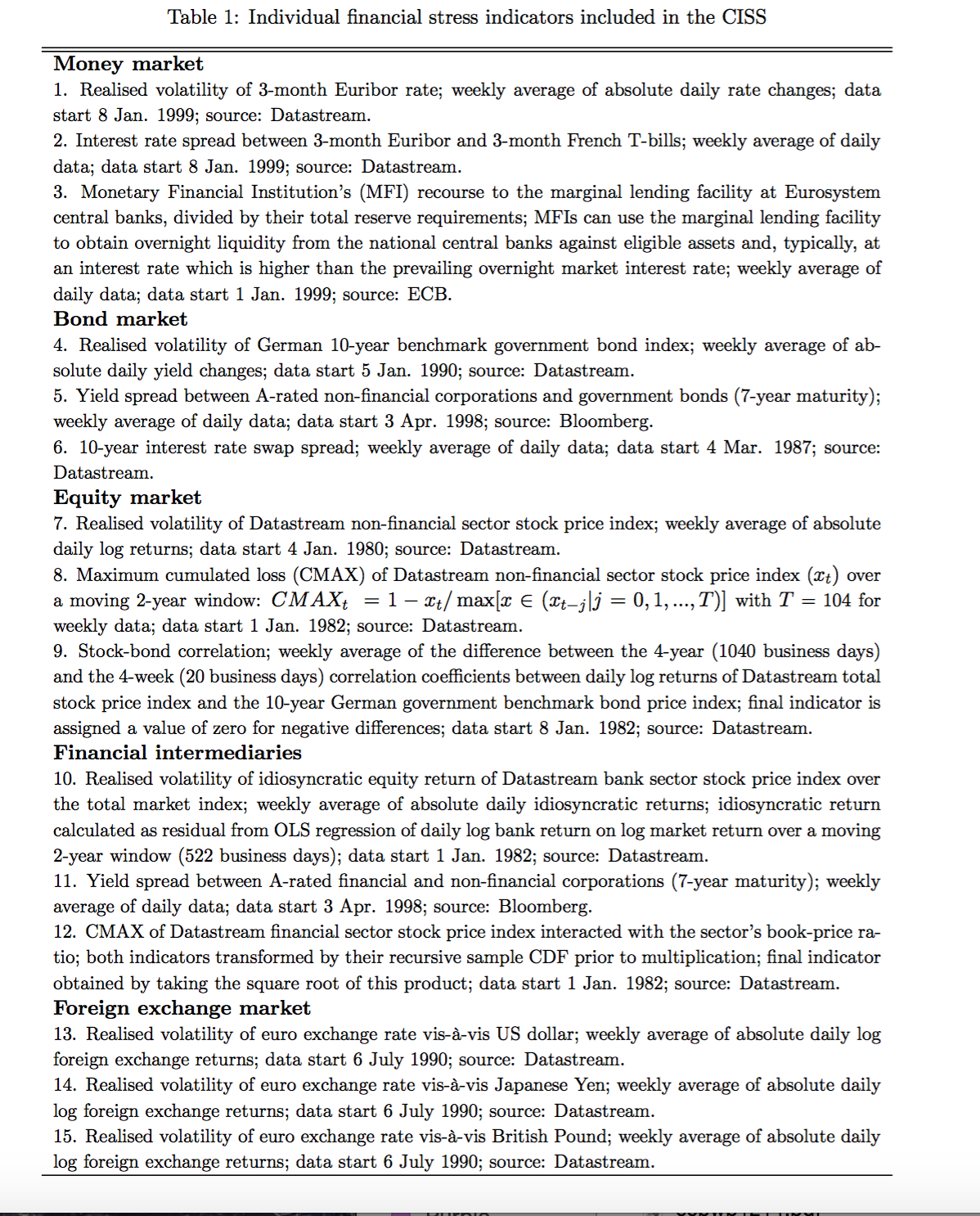
The European markets did sell off this week on the move to a referendum in Greece, but many, myself included, were surprised by how muted the move was relative to the headlines. There was some contagion to other markets but again less than expected. Clearly, the capital controls are a new twist to the problem, but a referendum is not going to be a definitive event. We do have evidence for why the equity moves have been muted or at least we have data that supports the muted results. The ECB has constructed a composite financial stress indicator index which which they have been updating on a weekly basis. The last reading is from June 30th which includes data through the 26th of June.

The CISS index has five subcomponents and 15 variable that are used to construct the indicator. The systematic stress indicator is looking for  a single measure that affect all of the European economies. The indicator used are listed below.


We expect that the reading will increase but the size will not match the previous periods of contagion.


This weekly index does not have the most recent information but the levels of stress are no where near the levels seen in 2011 and 2012. Levels were higher in 2002-03. We may see an stark increase in the next reading but the overall tone is more subdued and does not suggest that the financial environment was in any danger close to the end of the  month.


Tuesday, September 23, 2014

G20 views

"We are mindful of the potential for a build-up of excessive risk in financial markets, particularly in an environment of low interest rates and low asset price volatility. We will monitor these risks and continue to strengthen macroeconomic, structural, and financial policy frameworks, and other complementary measures, as the best response to managing risks, and meet our G20 exchange rate commitments." 

What kind of world am I living in when the G20 states that it is mindful of excessive risk that they created through excessive liquidity? Central banks created low interest rates and low volatility. Now they are going to watch and strengthen the frameworks to protect investors? This is code for more regulation and financial repression which will hurt investors. Central banks, by cutting rates to negative levels, created the "search for yield". Bank regulation created the opportunity for "shadow banking" which now needs to be better controlled. 

The G20 has created a risky environment and now want to change the framework to control the risks that they formed. In what world does this make sense? The investor advice has been to "not fight the Fed" and stay long to ride the liquidity wave. This will be good advice until it does not work.

Friday, September 19, 2014

Germany and the fiscal policy of austerity

German finance minister Schauble is not going to be “led astray” by higher deficits, so Europe will not get help from German fiscal policy.  They want to see structure reforms without spending money. This emphasis on structural reforms will determine the future of Europe. 

Regardless of the pressure placed on it from all forms of government institutions around the world, Germany has been holding the line on fiscal prudence. Only in the macroeconomic world will most believe that fiscal prudence is running greater budget deficits to increase aggregate demand and offset the "paradox of thrift". The macroeconomic religion says that you have to believe in fiscal multipliers that are above one and will stimulate private spending.

The yen and Abenomics


The yen decline may be the one part of Abenomics that has gone right, or has it. The yen continues to fall which is what was wanted and needed for Japan, but much of this has to do with a strong dollar and the end of QE by the Fed as much as the QE program in Japan. The stronger relative economic performance in the US has also helped the yen decline. Japan inflation has not increased as expected. Japan now needs to see an increase in exports.   

The idea of a yen fall was to create an environment for greater exports and more growth. If you get higher import prices but no growth all you have is lower real income which is not the plan. There is a difference between a steady decline and a yen fall-off and right now we have the later.