Saturday, January 29, 2022

Machine learning, deep learning and creating an investment edge


Learning to be smarter and run faster is a core part of the hedge fund business. Markets are fairly efficient, so there is always a desire to find an edge. And, if you have an edge, you have to accept that it may not last, so you should be looking to enhance the edge or look for a new one. There are several ways managers can create an edge:

1. Information advantage - get new and better information. This is a big new business with new alternative data sets.
2. Processing advantage - Look at information differently.
3. Operational advantage - Be faster at trading and operational efficiencies

Machine learning and deep learning are focused on generating an information processing edge, yet they approach the processing edge problem in very different ways. It is important to understand the difference between the two. 

Machine learning is directed by the analyst, so the process edge starts with the quality of the analysts who is picking the features being used in a model. Deep learning is not driven by the feature choice of the analyst but by the data processing of the information and the ability of the model to extract relationship. The expertise with deep learning is on raw processing as opposed to managing relationships of curated information. 

Is one approach better than another? My preference is with machine learning and using expertise to focus algorithm construction on key features. Deep learning can generate unique insights but will not have the important feature of explainability. Press on explainability and core features before resorting to deep learning classification.
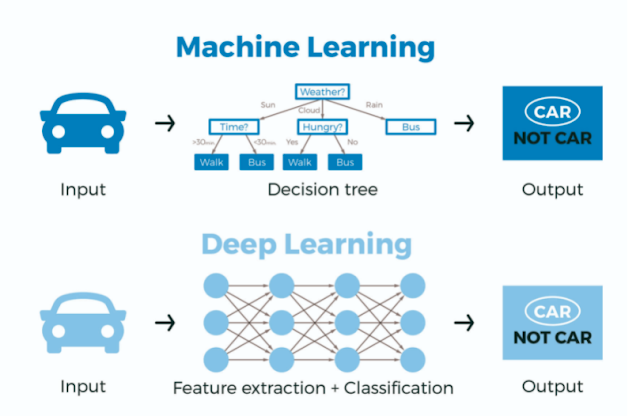
source: Bismart.com
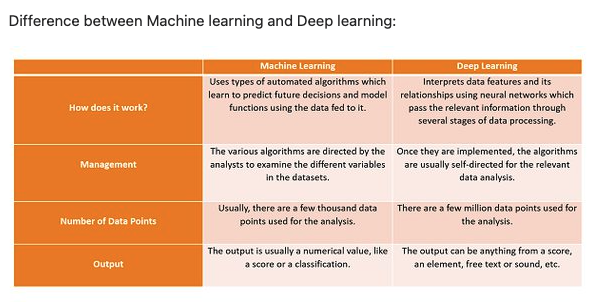
source: Artificial Intelligence Solutions | USM 
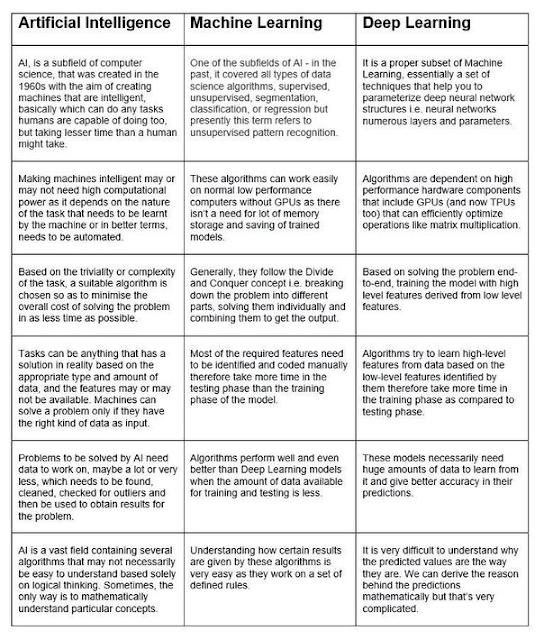

source: Anil Gupta


The problem of "should" and "is" with investing


"Market should do X, therefore I will do Y."

"Market is doing X, therefore, I will do Z."

One word separates the difference between the two statements above, yet that makes all the difference in the world. 

The "should" investor believes that he understands market dynamics and behavior better than the market itself. He has a view of value and believes that he has predictive behavior. "The market should reaction to the Fed." "The market should rebound." "This stock is overvalued and should decline."

The "is" investor believes that all key information is wrapped in the price. The trend-follower is the perfect "is" investor. "Prices are rising, there is a trend, and I should buy the trend." There is less analysis and more acceptance of what the weighted opinion of all market players is telling us. 

The believer in efficient market falls within this class. The investor who can express behavior in probabilities can be an "is" an investor. However, there is a difference between saying there is a likelihood and saying the market should behave in a certain manner.  

It is hard for many to always be an "is" investor. We would like to be a wise "should" investor; however, the should investor usually does not have a good track record. Hence, it is critical to understand and appreciate the difference between should and is. 


Thursday, January 27, 2022

Equity investing - It is all about the timing of cash flows


Equity investing is all about cash flows - how large will they be, and when will they be coming.  If you can get the guess on cash flow right, you will be a good investor. Yet, forming future cash flows is not easy. Extrapolation usually does not work because there will be fluctuations with the business cycle. Some industries will react quickly to a macroeconomic shock while others will see slow reaction. There will be industry leaders based on cash flow reaction and laggards. Given this differential timing, laggard industries can learn from leading industries, which is the view of researchers who have written the paper, "The Leading Premium". 

The researchers find that those industries that are leaders receive a meaningful premium relative to lagging industries. This empirical result makes sense on two levels. One, industries that will reach strongly and immediately to macro growth shocks will price in a premium for the added risk. Two, leading industries tell us something about future risks for lagging industries. Leaders resolve uncertainty for laggards. 


The authors do some heavy lifting to show the lead-lag relationships between growth and industries, but the story makes sense on an intuitive level. The difference in earnings (dividends) and thus pricing between leading and lagging industries is a forward equity premium. Industries that will have a strong and immediate reaction to a macro shock will have more risk than those that lag a macro shock. Sensitive industries will generate a premium and provide insight on the less sensitive industries. 

Tuesday, January 25, 2022

Yes, there is opportunity for macro trading with equities


The macroeconomic regime matters. Regardless of style, if you tilt to industries that have historically had higher Sharpe ratios in different economic regimes, investors can add value to their portfolio. Call it industry business cycle rotation, but accounting for simple macro regimes to industry allocations will improve portfolio performance. 

Industries will perform differently across the business cycle, but many have viewed that predicting the macro regime is difficult. A careful research paper takes a relatively simple approach to address this problem and show macro timing value. (See "Does History Repeat Itself? Business Cycle and Industry Returns".) 

Industry Sharpe ratios can be categorized across business cycle regimes. Given this information, the researchers make a judgement of the macro regime based on the output gap at the end of the year for the next year. Sorting the industries between long and short portfolios, it is found that buying high Sharpe ratio industries conditional on regime will outperform the market portfolio and a short portfolio.


The business cycle is measured through the sign of the output gap each year. The output gap is the deviation of growth from a linear and quadratic trend. This industry business cycle effect is robust to different measures of the business cycle.

According to the authors, the reason for this industry rotation edge is that investor do not seem to account for the impact of the business cycle on future cash flows. Albeit simple, investors are often surprised by the changes in firm cash flows across regimes and seem to under-react to these cash flow changes.

This industry effect is present even after accounting for the usual Fama-French factors and robust to industry momentum which has been found in the past to be significant.