Friday, January 4, 2013

Equal weights have value in commodities

One of the easiest ways to beat an index is to use diversification in your favor. The value of diversification increases with the decline in correlation across markets. When there is lower correlation, having more equal weighting will be valuable to a portfolio. A simple case is looking at the equal weighted Rogers Commodities index RICI versus an equal weighted portfolio. The RICI is the most diversified commodity index and commodities generally have lower correlation than equities. Even in this case, there is value with holding an equal weighted portfolio. 

If you do not have a forecasting edge, the easiest way to sleep at night is to take the 1/N rule. Equal weight and go home. You will do well in the long-run.
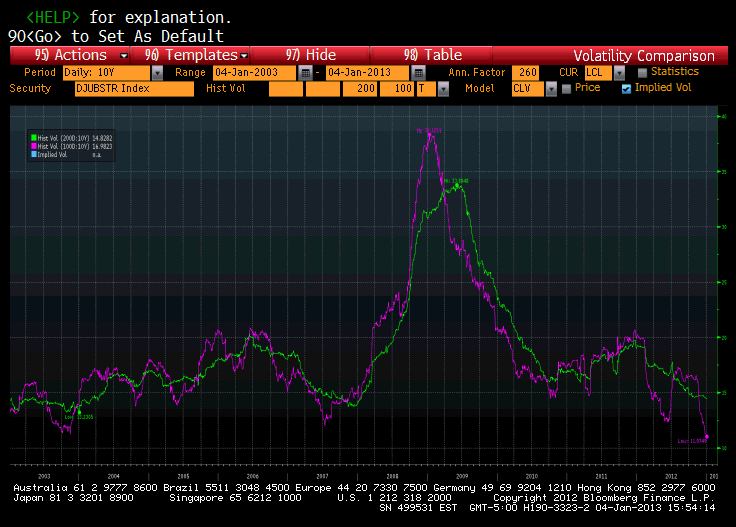
Commodity volatility at 10 year lows


Commodity volatility has fallen off a cliff and is now at 10 year lows based on 100-day moving averages. The 200-day moving averages are also close to the lows reached in 2003. There was no volatility increases from the fiscal cliff. There was no increase from the EU sovereign events of 2012.  We are at 1/3rd the volatility in late 2008 and early 2009. 

Even with the shortages in agriculture from the drought the overall index has been on continued down-trend. Agriculture volatility has stabilized at a higher level than found in the 2003-07 period. Energy volatility has continued to stay low for the last 30 months. Precious metals volatility has declined through the year and is below the 10-year averages. The same trend applies to industrial metals. The world has been a calm place for commodities and it is not clear what will change this trend.

BOJ holds the fate of Japan

After years of deflation, Japan may be in a place where they are willing to accept inflation to help stimulate the economy. Deflationary expectations have been a part of the Japanese mind-set for years. The Japanese have now picked a Prime Minister, Abe, who is going to do everything in his power to raise inflation and get the economy moving. 

Third quarter real GDP is up only .5% . Nominal GDP was down -.3 percent. The GDP deflator was down -.8 and has been negative every quarter since 2009:q3. Except for 2009, every quarter for a decade has been seen a negative GDP deflator. There was not resolve to raise prices.  There was a period of positive GDP deflator numbers in 1997-98 but 20 years of data shows only 7quaters out of 80 which were zero or positive.

The BOJ has the control of money and it has to use the unconventional means discussed by Ben Bernanke to get inflation higher and the yen lower. Just the thought of change has seen a 10 point decline of the yen since October from 78 to 88. Now, there has to be concrete monetary action to further this trend. Here is a special case where getting prices higher and hurting wealth holders may be for their own good. Of course, the rest of the G7 may be thinking about similar plans.

The year of the butterfly in currencies


The currency markets 2012 can be viewed as the year of the butterfly. A look at the performance of the DXY dollar index showed relatively flat performance for the first four month and flat performance in the last quarter which represented the wings. The middle of the year was marked by a flight to the dollar in response to renewed problems with Euro-zone crisis. The dollar reversed this strengthened on the renewed commitment of the ECB President Draghi to do whatever it takes to provide liquidity to the bond markets. An expectation that Fed Chairman Bernanke would actively extend monetary easing through a QE3 also brought the dollar back down to its ranges seen earlier in the year. For currencies, this was the classic risk-on and risk-off with the dollar rallying on sovereign risk only to reverse once policy-makers offered a liquidity solution.  

 Our butterfly pattern would have made the “Rip Van Winkle” test or “Sleep-Test” operative. An investor who went to sleep at the beginning of 2012 would not have noted a significant change in dollar performance when they woke-up at the end of the year. The exception to this relative stability year over year was the significant sell-off in the yen which has hit 28 month lows. Here, someone would have awakened to a new yen world.