Friday, January 2, 2009

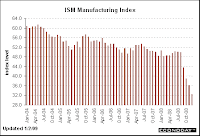
Manufacturing decline a poor way to start 2009


ISM manufacturing index has seen the fastest decline since the 1980 recession. The fall-off since July is startling and ends any hope that manufacturing will offset the declines in housing. More importantly, the export sector was viewed as a bright spot earlier in the year but the sharp fall-off provides more evidence that there is a global growth slowdown. The US is not sending goods abroad and Asian economies are not sending goods to the US. The fall-off in exports from Asia and China in particular has been dramatic. See http://www.nytimes.com/2009/01/01/business/01exports.html?em

The link between China and the US is so strong that many are now calling the economic relationship or partnership Chimerica. An important issue will be how both countries continue this partnership. Much of the manufacturing decline will be placed on China which has been the main factory for "platform companies" like Wal-mart and other retailers. China will also have to continue to be an important buyer of debt. Given the cost to China in both the real and financial sectors, the question will be what will the US do for China. The simplest action will be to maintain an open trade door, yet this will also be the easiest policy for the US to change through erecting trade barriers. One hopes that we do not see trade barrier legislation like Smoot-Hartley from the 1930's. This will only prolong the current problems.

Tuesday, December 30, 2008

Farrell's ten rules of investing - a good checklist for anyone

Marketwatch gathered some of Farrell's more famous observations, and republished them as "10 Market Rules to Remember." These rules were also mentioned in a recent Bloomberg story as well as a Big Picture Blog in August.

1. Markets tend to return to the mean over time
When stocks go too far in one direction, they come back. Euphoria and pessimism can cloud people's heads. It's easy to get caught up in the heat of the moment and lose perspective.

2. Excesses in one direction will lead to an opposite excess in the other direction

Think of the market baseline as attached to a rubber string. Any action to far in one direction not only brings you back to the baseline, but leads to an overshoot in the opposite direction.

3. There are no new eras -- excesses are never permanent

Whatever the latest hot sector is, it eventually overheats, mean reverts, and then overshoots. Look at how far the emerging markets and BRIC nations ran over the past
6 years, only to get cut in half. As the fever builds, a chorus of "this time it's different" will be heard, even if those exact words are never used. And of course, it -- Human Nature -- never is different.

4. Exponential rapidly rising or falling markets usually go further than you think, but they do not correct by going sideways. Regardless of how hot a sector is, don't expect a plateau to work off the excesses. Profits are locked in by selling, and that invariably leads to a significant correction -- eventually comes.


5. The public buys the most at the top and the least at the bottom

That's why contrarian-minded investors can make good money if they follow the sentiment indicators and have good timing. Watch Investors Intelligence (measuring the mood of more than 100 investment newsletter writers) and the American Association of Individual Investors survey.

6. Fear and greed are stronger than long-term resolve

Investors can be their own worst enemy, particularly when emotions take hold. Gains "make us exuberant; they enhance well-being and promote optimism," says Santa Clara University finance professor Meir Statman. His studies of investor behavior show that "Losses bring sadness, disgust, fear, regret. Fear increases the sense of risk and some react by shunning stocks."

7. Markets are strongest when they are broad and weakest when they narrow to a handful of blue-chip names

Hence, why breadth and volume are so important. Think of it as strength in numbers. Broad momentum is hard to stop, Farrell observes. Watch for when momentum channels into a small number of stocks ("Nifty 50" stocks).

8. Bear markets have three stages -- sharp down, reflexive rebound and a drawn-out fundamental downtrend

I would suggest that as of August 2008, we are on our third reflexive rebound -- the January rate cuts, the Bear Stearns low in March, and now the Fannie/Freddie rescue lows of July. Even with these sporadic rallies end, we have yet to see the long drawn out fundamental portion of the Bear Market.

9. When all the experts and forecasts agree -- something else is going to happen

As Stovall, the S&P investment strategist, puts it: "If everybody is optimistic, who is left to buy? If everybody is pessimistic, who's left to sell?" Going against the herd as Farrell repeatedly suggests can be very profitable, especially for patient buyers who raise cash from frothy markets and reinvest it when sentiment is darkest.

10. Bull markets are more fun than bear markets

Especially if you are long only or mandated to be full invested. Those with more flexible charters might squeak out a smile or two here and there.

I occasionally crossed paths with Bob when I worked at Merrill Lynch as an analyst. He was strong researcher and true gentleman. He is an example of what we should aspire to be as a finance professional, colleague, friend, and neighbor. I wish I knew him better because I would be better because of it. This is not meant to be a eulogy but just the truth.

Monday, December 29, 2008

Should I feel better? Not by Yale Crash Confidence Measure

The stock market has become more range-bound over the last few weeks, but that has not changed the pessimism in the markets. The Yale School of management has produced a relatively long history of stock market confidence by both institutional and individual investors. http://icf.som.yale.edu/confidence.index/CrashIndex.shtml. The chart shows the confidence that there will be no crash in the next six months. This index reached a low after the end of the tech bubble after which there was a strong equity upturn.

Sentiment is not very strong as we end the year. Consumer confidence also reached a new low this week so this economy needs a good jolt of optimism to get spending and lending to pick-up.

Sunday, December 28, 2008

TMPG as important as any government lending program

The focus of the credit crisis has been on government provding funds to substitute for the failure from private lending, yet some of the rules and regulations can be changed to enhance private lending and liquidity. The Treasury Market Practices Group (TMPG) may be as important public -private partnership through setting standards in the Treasury market. In particular, suggested changes in the repo market where there has been a significant increase in the number of trading fails may be an important mechanism for normalizing lending in Treasuries. Increased liqudity in the repo market is imperative to better establish a lqiudity for makret maket-makers. This issue has to be solved before the spike in Treasury issuance hits the markets.