Showing posts with label international trade. Show all posts

Sunday, February 15, 2026

The complexity of trade - not always simple


Those imports are taking away good jobs. We have to impose tariffs to stop the invasion of foreign goods to our shores. These comments all sound good, but the reality is more complex. It is usually always that way. One chart that caught my attention showed that many good imports are intermediate goods rather than final products. We take in components and assemble the final product. As an intermediary good, a tariff will increase the price of the final good. The answer could be to produce these intermediate goods in the US, but they are often specialized and may be hard to produce at low cost. Some industries are very dependent on these imports, and they do not fit the usual trade story being used to justify tariffs. Think about complexities and realize most problems are not easy yes or no answers. 

Thursday, January 1, 2026

What will be the impact from tariff in 2026


The standard trade world seemed to be coming to an end during the Liberation Day debacle, yet the US moved away from its strongest tariff rhetoric, and the world seemed to adapt to a higher-tariff environment. The worst tariff policies were not implemented, yet many policy effects take time to take effect. Firsm can adjust pricing, reduce profit margins, hold-off prcie increases, yet many responses are temporary.  Goods shipments increased, but now both importers and exporters will have to normalize in a world with a higher tariff. For Chinese manufacturers, this will mean tighter margins, but it will also likely lead to a shake-up of firms and industry-wide considerations. This will be a global effect. 

The end of the Great Globalization


Every analyst develops and markets year-end forecasts, but the most important part of forecasting is not knowing where we are going, but knowing where we are in the world economy. You cannot map the future if you do not know the current or past, and the critical issue is the end of globalization. Many discuss tariffs, but the real problem is what will happen to global trade and foreign direct investment. 

Global trade is showing flat growth, and FDI flows have fallen significantly. There is a change in relative trade; however, for most living standards, the overall trade flattening is the key driver of growth. 

The Great Globalization is over, and we will all suffer from this in 2026.

Friday, April 18, 2025

Supply chain globalization - a complex system


Trade and globalization today are not the same as 50 years ago.  In the old world or stylized world of trade, final goods are shipped between locations. Raw materials are traded for a finished good. It was easy to see where the value-added was generated. Of course, there still are finished goods traded for finished goods, but a growing portion of trade is in unfinished goods as part of a supply chain. In the supply chain trade, a single corporation may outsource the manufacturing of some parts in another country, which is then sent to another country, and then finally sent to the US for finished production.

Production is determined by labor costs and specialization, as well as the transfer price for parts. Welcome to multi-national supply chain trade.  Hence, the tariff on a part may only be a small part of the total cost of production, but the impact of tariffs becomes hard to measure because many goods made in the US may have components from a foreign country. If tariffs impact deliveries, while parts are assessed for tariffs, there will be a disruption of the supply chain, which will impact the finished production. There will be a congestion "tax" associated with the processing of imports, which will create bottlenecks across the US. We are not making a value judgment but rather assessing the impact of tariffs and what they may do to the US economy. 

There needs to be a realization that any economy is a complex system, which means that disruptions to the processes that make the connections across production will have an impact on the system and will require adjustments that will cost both time and money.

Wednesday, April 16, 2025

The changing global trade mix - World trade is different


We produced a variation of this table just last month with slightly older data, yet it is a critical visual that needs to be digested. The US is not the leading trading partner for most countries. That ship has sailed. This has all happened in the last 25 years since China entered the WTO. There are many reasons for this change, but a combination of cheap labor and mercantilist policies was able to change world trade in favor of the Chinese. This is the headwind impacting a change in US trade relations. A strong dollar, higher relative wages, and less focus on trade have pushed the US to a lower trade status. Diving deeper into these numbers with EM countries suggests that China is a leading trade partner because it is importing raw materials; nevertheless, if China is your main trading partner and also provides financing, global markets will adapt and offset the dollar-focused inertia.   

Tuesday, April 15, 2025

Rodrik and the contradiction between globalization and sovereignty


Those countries that choose more globalization lose their domestic sovereignty, while those that limit globalization can have greater control over their domestic economies. This is the thesis of Dani Rodrik, a unique thinker on trade and globalization issues.  The issue is not either black or white, but accepting hyper-globalization will impact an economy driven by the behavior of other countries. Independence in sound production and capital movement is lost. There is a substantial benefit, but in the extreme, cheaper imported goods may hollow out internal production, which generates less domestic control over the economy. Globalization may be at odds with national security. Again, there is a loss of control. The globalization shock worldwide was swift, often with limited consideration of the long-term impact, yet reversing the effects of hyper-globalization is not simply a reversal of the trade. The process of deglobalization, even on the margin, takes time and will have costs. 

Solving a contradiction is not without costs. There will be winners and losers, and it takes time. A process of reversal will be painful and needs careful consideration.  

Sunday, April 13, 2025

The four eras of trade? Douglas Irwin's view


Douglas Irwin—there were three alliterative eras: “revenue, restriction, and reciprocity.” Yet we may be in a new fourth era of retribution.

The first era was the period pre-Civil War when tariffs were used as a revenue generator. The second post-Civil War period was one of tariffs that restricted foreign competition and allowed US manufacturing to grow. The post-WWII period was one of reciprocity, where the objective was a mutual decline in tariff levels. This led to a great explosion in global trade through GATT and the WTO arrangements. 

The Trump era may be a combination of the first three with a fourth objective of retribution for those who cross the Trump objectives. Irwin's assessment seems to be a good framework for thinking about trade issues beyond the tactical issues of new policies.

Tuesday, April 8, 2025

Kindleberger would not be happy with Trump


DeLong and Eichengreen argued that Kindleberger had seen how the “ability and willingness to bear the responsibility and sacrifice required for benevolent hegemony [was] likely to falter” in the United States way back in 1973. Kindleberger anticipated, they argue, what went wrong in 2012 — “extraordinary political dysfunction in the United States preventing the country from acting as a benevolent hegemon, and the ruling Mandarins in Europe, Germany in particular, unwilling to step up or convince their voters that they must assume the task” - Angus Bylsma

There is a US responsibility to guide the global economy. Some may say this is a myth in the current world before Trump, but clearly, President Trump has a different vision that does not include benevolent hegemony. Instead, it is a new form of isolationism based on a perception of trade fairness. Should the foundations and costs of the benevolent hegemony be discussed and adapted to the changing multi-polar world of the 21st century? Of course, rapid change creates uncertainty, and with uncertainty, there is an increased chance of mistakes as countries act and respond. 

Kindleberger's great work on the Great Depression focuses on a combination of economic mistakes and not a single monetarist story. The uncertainty of the 1930s created a set of conflicting policy goals and actions that exacerbated a fragile system after a crash. There was a lack of leadership and vision to coordinate global action to serve the common good. Perhaps this view is Pollyannish or only available through hindsight, but coordinated action across countries is needed, not a singular focus on interests followed by bilateralism.

Sunday, February 16, 2025

How world trade has changed - the real issue


While the US has been focused on tariffs, the real issue is the change in world trade between the US and China. Raising trade barriers will not solve this problem. A strong dollar with a decline in manufacturing with China being a strong export producer has changed how the world trades. Mexico and Canada make up about 40% of all our imports and exports, so this is one area that we must get right.

Trade is an important reflection of US power and hegemony, so a policy of trade isolation will diminish the power of the US around the world. 

Sunday, January 19, 2025

Where are trade flows going?


Everyone has been talking about tariffs, but the larger issue is how trade flows will change over the next decade. Follow the trade flows and you will be following the geopolitics of nations. We are not living in a mercantilist world, yet the dynamics of trade will influence the relationships of nations. BCG has done a good job of describing this issue with their white paper "Great Powers, Geopolitics, and the Future of Trade".

The BCG report does a good job of describing and putting numbers to the key trade drivers that will drive geopolitical issues over the next ten years.  We will see the forming of stronghold North America which will isolate itself from the rest of the world through tariffs. Second, we will see a continuation of the great China pivot away from the US. This will be matched by the rise of the global south, the ASEAN growth transition and the ascent of India trade. Finally, there will a new focus on EU competitiveness to offset the losses from trade with Russia and China. 

These changes will have an impact on commodity flows as well as finished goods. We should also see these changes impact capital and equity flows. 


Saturday, December 14, 2024

Competition across nations starts at home


I was recently discussing the Draghi report on EU competitiveness and stated thinking about the old work of Michael Porter and his work The Competitive Analysis Across Nations which was an extension of his work on competitive analysis of firms. Porter developed the five forces diagram which is followed by most business students when they study strategy analysis.

For his study of nations, Porter developed his four diamond graph which is based on analyzing: factor conditions, the endowment of resources; the firm strategy or domestic conditions; demand conditions for what is needed, and the infrastructure of other industries. Governments can help with the environment, but countries do not have competitive advantage, industries do. Governments cannot make companies be more competitive. It can only create an environment that allow for competition. The private sector is where there is innovation and gains in productivity. If the EU wants to be more productive, then let companies compete gain scale and meet market demand. 

Sunday, March 3, 2024

Outside the Box - Good book on understanding globalization


A book on international trade and globalization is not supposed to be interesting reading, but Outside the Box: How Globalization Changed from Moving Stuff to Spreading Ideas by Marc Levinson is an enjoyable book filled with details to truly understand how the world had transformed through trade over the last century. This not a dry thought piece on trade. It filled with stories about container ship, the trafficking of good around the world and details on the consequences of trade policies that have changed the world. If you are at all interested in the question of trade, then this is a good place to start.

The rise and fall of globalization - The change in eras


We need to think about large and important economic era beyond the business cycle to truly understand what may happen to international returns. There have been three great eras of globalization that have changed the world, and we are in another period of transition which can be described as the fourth great globalization. 

First great globalization (1.0) - the period of the last quarter of the 19th century until the beginning of WWI. The combination of the industrial revolution with cheap transportation, and a growing financial banking sector allowed for the transfer of manufactured goods and commodities around the world. This abruptly ended with the Great War in Europe. Trade growth did not return until the end of WWII.

Second great globalization (2.0) - The period from the end of WWII until the end of the 1980's. The regrowth of Europe coupled with lowering of tariffs and dollar-based currency system allowed for strong increases in trade among countries.

Third great globalization (3.0) - The period from 1990 until 2008 and the great financial crisis. In the third era, manufacturing was sent to the cheapest source of labor and the modern supply chain management was used to integrate economies around the globe. Capital was moved around the world based on growing diversification of sourcing of goods and services.

The possible fourth globalization (4.0) - This is what we are living in today. The post-GFC period and the search for new trade relations. There is growing regional trade across blocks with also a change in tariff and sanction dynamics. The cost of trade has increased, and the flows capital and goods have moved with a growing belief in on-shoring and friend-shoring. This cuts some the financial and trade links that were present during the third globalization.

Monday, September 18, 2023

Mexico is now our top trading partner


The trade world can change very fast. China was the dominate trading partner with the US by a significant margin, but that is no longer the case. Mexico has been the beneficiary for on-shoring, near-shoring, or friend-shoring. Regardless of the name, the US is willing to tighten trade links with Mexico over China. Of course, China could be exporting goods to Mexico, and these are forwarded to the US in an effort to beat some tariffs. While the talk about friendly trade links with China has been in the news, the reality is that companies are switching supply lines. 

Wednesday, July 12, 2023

Concentration problem in key industries - This is to going to be easily solved


There has been growing talk about derisking and or decoupling trade with China as if this is something like a switch to either turn-on or turn-off. The global economy does not work that way. Supply chains are not easy to change. Capital has been committed across borders. Industries have developed around geographic locations for the simple reason that resources are in certain regions of the world. This is especially true with production for some key security technologies. 

The US and the world are especially sensitive to trade with China and the idea that we can decouple or derrick in the next year or two or five is just fantasy. These industries will be a major stress point for markets over the next half decade.

Sunday, January 22, 2023

International trade concentration is a problem not discussed


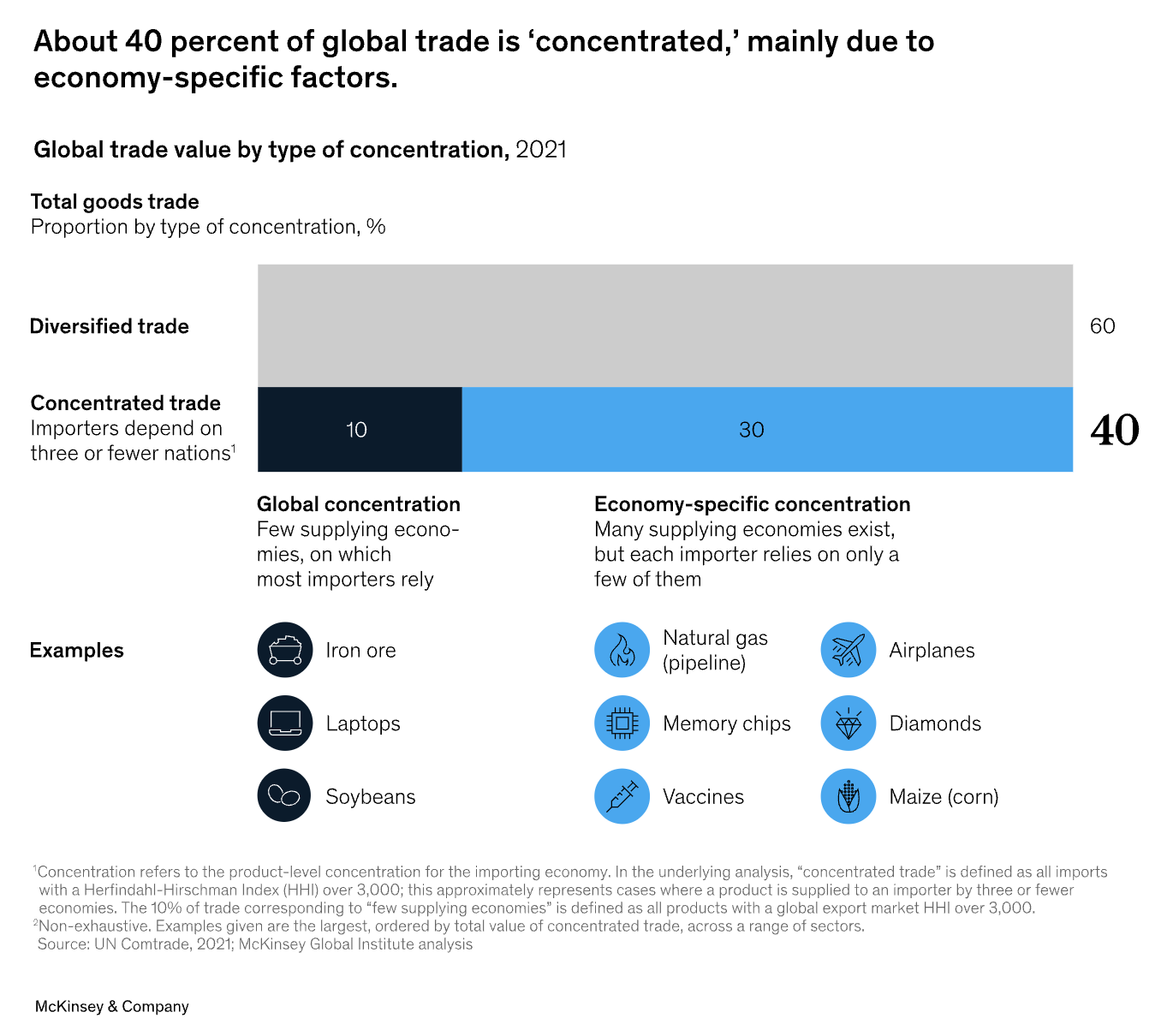
While everyone talks about international trade as a complex web of competitive suppliers, the reality is different with a high level of concentration in many key industries. The high concentration with few suppliers means supply disruption like we have seen over the last two years are more likely. See McKinsey Global Institute "The complication of concentration in global trade". 

About 40% of global traded is concentrated with only a few suppliers. Importers around the world are dependent on these key suppliers so a trade disruption cannot just be solved. by moving business to a different firm. Pandemics, sanctions, supply chain disruptions will all be magnified if shocks are focused in these key industries. Manufacturing may be competitive but the raw inputs may be concentrated, so international dependency is significant. This is especially true with agriculture, mining, and electronics. Supply shocks may be more prevalent given this concentration which will translate into higher "inflation". Supply chains matter.


Tuesday, November 8, 2022

Economic trade projects diplomatic power


Economic power projects diplomatic power. Trading partners will listen to each other. This is both a reality and necessity; however, the influence may be one-sided.

Economic powers will project their values, political system, and culture. It may not happen immediately; however, cultural and political hegemony will march with economic trade. 

The switch in trading hierarchies from the US to China is astounding and consistent with the strong growth in China and its need for resources. The China effect is driven by extraction from emerging markets and the sale of goods to developed markets. This process is still relatively young so the credit, banking, and currency implications have still not matched the trade relationships. 

Given the current struggles between the US and China, the exertion of power on trading partners will grow. China may not look for active but silent partners who will not interfere with their politics. The US will look for friends to shore its trade, but it is less dominant around the world. All this will play-out in debt and equity markets as EM firms may have to side with their economic interests. We have already seen some of these trade politics play through the oil markets. 

Monday, June 6, 2022

Davos and globalization


The researchers at the World Economic Forum (WEF), Davos, presented a white paper on globalization that is worth thinking about. It divides the future of globalization into four scenarios based on a two-by-two matrix of physical and virtual fragmentation or integration. Global connections can be through either through physical trade or some form of virtual or non-physical trade which represent high tech integration. (See "Four Futures for Economic Globalization: Scenarios and their Implications" White Paper May 2022 WEF.) I prefer a physical versus services trade matrix with a third dimension associated with finance, but we can use the WEF for discussion.

The physical trade world is clearly disrupted on two dimensions. Supply chain problems from the pandemic have altered how firms and countries view logistics and where they are sourcing goods. The Ukraine War has created a new view that each country must think about self-sufficient with respect to key physical goods like food and energy. The virtual globe world is changing rapidly as countries attempt to control the flow of data and communication. 

Scenario 1 represents the old world of globalization prior to the pandemic. It may be the desire for many to move back to this world, yet it is less likely given the shock events of pandemic and war. Even the virtual world may see less integration although it many have switched from physical contact to virtual communication. Physical integration may occur albeit less concentrated with fragmentation of e-commerce and communication. The reverse of physical fragmentation and virtual integration is the opposite choice with selection to bring manufacturing home but outsource some intellectual activities for cost benefit. 

Nevertheless, the great fear is a movement to isolation around the world as nations attempt to protection commodity sourcing and onshore more activities. The US has started to discuss the idea of friend shoring where countries pick their trading partners as a way of protecting national interests. This will be the great fear to the liberal order of free trade and will have strong implications for firms trying to navigate cost minimization.

The bottom-line for investors is that country financial markets will become delinked and reduce correlation. International diversification will increase but there will be greater dispersion in returns and more room for active investing. Nonetheless, the focus will change from picking firms to picking countries based on strategic partnerships across governments.  

Friday, April 22, 2022

The liberal world order and global arbitrage


Globalization and the liberal world order can be viewed through the impact of market arbitrage and the law of one price. In a globalized world based on free trade, higher prices in one country will be offset by importing to increase supply and take advantage of any price discrepancy. For commodities, there will likely be one world price after accounting for transportation costs, tariffs, and processing. In the case of energy, oil or natural gas will converge to one price. Of course, this may not fully represent reality, but it is an ideal which is a driving force behind market behavior.

The law of one price can be applied to capital and labor. There will be winners and losers as market equilibrate to one price, but uncertainty is reduced. Investment decisions can be based on the law of one price. Access to commodities will be at the world price so considerations for plant location will be based on labor costs and nearness to the consumers. The law of one price will increase economic efficiency.

In a world where it is more difficult to achieve a world price for commodities, trade and manufacturing will have to be reconfigured. If there is a breakdown in trade as well as the free flow of labor and capital, market inefficiencies will arise, and optimal global growth will not be achieved. Those without access to supply will see growth languish as resources are squandered to support an inefficient world.

Equity and bond markets will not be integrated and return dispersion will increase and correlation across markets will decline. Holding international portfolios will become riskier at the same time diversification will increase. There will be winners who exploit inefficiencies, but consumers will be net losers. Country and regional assessments will need to be improved because declining integration create structures to deal with supply shortages. Finance and investing will be harder with a greater focus on local market dynamics. We have not seen this type of disorder in decades and it represents a headwind that reduces consumer welfare.

Saturday, March 26, 2022

The "happy age" before WWI and the new globalization "dark ages"


 … any man of capacity or character at all exceeding the average, into the middle and upper classes, for whom life offered, at a low cost and with the least trouble, conveniences, comforts, and amenities beyond the compass of the richest and most powerful monarchs of other ages. The inhabitant of London could order by telephone, sipping his morning tea in bed, the various products of the whole earth, in such quantity as he might see fit, and reasonably expect their early delivery upon his doorstep; he could at the same moment and by the same means adventure his wealth in the natural resources and new enterprises of any quarter of the world, and share, without exertion or even trouble, in their prospective fruits and advantages; or he could decide to couple the security of his fortunes with the good faith of the townspeople of any substantial municipality in any continent that fancy or information might recommend. 

He could secure forthwith, if he wished it, cheap and comfortable means of transit to any country or climate without passport or other formality, could despatch his servant to the neighboring office of a bank for such supply of the precious metals as might seem convenient, and could then proceed abroad to foreign quarters, without knowledge of their religion, language, or customs, bearing coined wealth upon his person, and would consider himself greatly aggrieved and much surprised at the least interference. 

But, most important of all, he regarded this state of affairs as normal, certain, and permanent, except in the direction of further improvement, and any deviation from it as aberrant, scandalous, and avoidable. The projects and politics of militarism and imperialism, of racial and cultural rivalries, of monopolies, restrictions, and exclusion, which were to play the serpent to this paradise, were little more than the amusements of his daily newspaper, and appeared to exercise almost no influence at all on the ordinary course of social and economic life, the internationalization of which was nearly complete in practice.

- The Economic Consequences of the Peace Keynes 

This was the age of globalization before WWI. How will writers express the period before 2022 in 10 years time? My guess is that we will express with longing the old era of liberal world order and global trade. It is ending, and we should expect markets to adapt to the new order of closed economies, focused production within borders, and limitation on investments and travel.