Showing posts with label banking. Show all posts

Monday, August 12, 2024

Banks from too small to too big - Is there room for innovation?


From too small to survive to too big to fail, there has been a significant change in bank risk given the huge economies of scale and consolidation in this sector. 

In the 1930's the problem in banking was an issue of too small to survive. Banks during the Depression were failing left and right. The same thing happened during the great thrift upheaval in the late 1980's. The problem was not size but number. 

Now the banking sector has changed. The small banks have been under the pressure of consolidation, and with commercial real estate problems, the issue of further consolidation will again be on the table, yet the real threat is too big to fail. 

The government will bail-out any large institution based on the threat of contagion. This does not mean that banks are cheap or good investments for shareholders, but it does tell us there is limited discipline with large institutions beyond what is required by regulations. With systematic stress testing, there will be greater similarity with large banks who meet stress-testing requirements. Regulation will drive many key decisions which will increase systematic behavior.

Can there be innovation in banking in a too big to fail environment? This is a question I have been thinking about and not sure of the answer. What have been the new innovations in banking? We know that technology has been used to control and cut costs, but this does not fall under product development.    

Sunday, December 17, 2023

Bank risks - Not understanding risks


 “Banks don’t go out of business taking risk, they go out of business levering the things that they’re told aren’t risky.” - David Dredge

Bank risk is always about the surprise risk. There was no risk with holding mortgages until there was. There was not risk with holding longer-dated Treasuries until there was. The bank conduct significant due diligence on their loans, yet mistakes are made. One mistake or an isolated mistake is expected, but systemic risk across a section of the entire portfolio is what hurts banks. Systemic risk with leverage matters. 

Saturday, April 29, 2023

Reread "The Bankers' New Clothes" - Still a fresh look at banking


It is 10 years since The Bankers' New Clothes was written by two of the best bank finance professors. It was supposed to explain the risks with banks and what we can do to diminish the risk to the economy and the government, taxpayers, who provide an insurance backstop.  We wrote about it in  What is it about bankers' clothes?  The argument of Admati and Hellwig its simple, banks need more capital and less leverage. Banks are not special relative to any other firm that uses leverage to boost profits. If banks make bad investments with leverage, the pain is real. We can talk about risk management and supervision but the best and first line of defense should be more equity in the business. 

Look at all the bank failures this year. The problem is the same as any in the past. More investments that turn unprofitable and blow through all the equity. The threat of losing equity makes any lender or depositor want to exit. Increase equity the downside risk is limited. Of course, greater equity will impact lending and bank decision making, that may end up being a good thing for the economy.  This does not change the original sin of zero interest rates for over decade; however, the responsibility of managing assets still rests with the bankers. 

Monday, March 20, 2023

Disintermediation - A word very relevant for banking today


Financial disintermediation has always been an important topic for financial institutions, but it has not been the focus of research when rates were close to zero. There was disintermediation from the reach for yield, so depositors kept balances low. For their liquid funds, there was not a lot of shopping for higher rates, because all rates were low. There was not advantage of moving to a money market funds because the excess yield was limited, and the absolute yield was low. 

Go to the pandemic and the world changed. First, deposits exploded given all the extra money in the economy. Banks could not lend the money and yields were low. However, inflation grew, and the Fed started to raise rates. It is now very rational to shop your deposits to higher yielding alternatives.  

Depositors will shop for higher yields at other institutions. They will shop at money market funds. They will use their excess balances for purchases. The result is a decline in deposits which means that something must happen on the other side of the balance sheet.  Assets must be sold. 

Banks that are not competitive with rates on deposits will see disintermediation. Firms with excess deposit balances will be drawing them down. If asset liability management has a gap, there will be a real cost to equity. We have seen the extremes with several banks, but this is a global problem. 


Thursday, March 16, 2023

Silent bank runs - Is there a need for withdrawal restrictions


When we think of a bank panic, the image that comes to mind is a long line of desperate depositors all scrambling for their money. Depositors are fighting to get to the front of the teller line. For institutions, there is the image of corporate treasurers on the phone yelling at bank employees to wire money. This is not reality. Bank runs are currently silent, a click of a button. There is a new spend with withdrawing money or sending funds.  There is no noise, no friction, just action. Money can move faster than  ever and many depositors will not even know it is happening.

There is a question of whether there needs to be more frictions in the financial system to combat panics. Funds have gating provisions which are usually not reviewed until the gate goes up. Of course, there will new responses if frictions are added, but the question should be asked; could we reduce the chance of a bank run by forcing withdrawal restrictions in depositors. I am not for it, yet technology creates new issues that must be matched by new regulations. 

Monday, March 13, 2023

Panics - Is the SVB event another perfect storm?


Robert Bruner and Sean Carr laid out 7 reasons in their book The Panic of 1907 why 1907 was a perfect storm for bank runs and a massive financial crisis:

1. Complexity. Complexity makes it difficult to know what is going on and establishes linkages that enable contagion of the crisis to spread.

2. Buoyant growth. Economic expansion creates rising demands for capital and liquidity and the excessive mistakes that eventually must be corrected.

3. Inadequate safety buffers. In the late stages of an economic expansion, borrowers and creditors overreach in their use of debt, lowering the margin of safety in the financial system.

4. Adverse leadership. Prominent people in the public and private spheres wittingly and unwittingly may implement policies that raise uncertainty, thereby impairing confidence and elevating risk.

5. Real economic shock. An unexpected event (or events) hit the economy and financial system, causing sudden reversal in the outlook of investors and depositors.

6. Undue fear, greed, and other aberrations. Beyond a change in the rational economic outlook is a shift from optimism to pessimism that creates a self-reinforcing downward spiral. The more bad news, the more behavior that generates bad news.

7. Failure of collective action. The most well-intended responses by people on the scene prove inadequate to the challenge of the worst crises.

from Ben Carlson - A Wealth of Common Sense 

Can we say that this is another perfect storm? Perhaps there is no such thing as perfect storm, but this is close. 

1. Complexity - This should be simple, but the accounting for banks is not simple. There is Hold to maturity (HTM) and available for sale (AFS) that have made studying bank risk more difficult.

2. Buoyant growth - The deposit growth for the three years before mid 2022 was very strong, much stronger than loan growth which created an investment problem.

3. Safety buffer - Many banks have reached for yield with longer duration which changes the safety buffers. 

4. Leadership - We are moving from a period of zero interest rates and QE to higher rates and QT. The guidance from the Fed has been mixed which has added to uncertainty. Bank leadership has followed strategies that have created more ALM risk.

5. Shocks - Between the pandemic and rising rates, the markets have suffered from an uncertain environment.

6. Fear and greed - Concerns or fear has caused a run on deposits.

7. Collective action - The funding of new equity failed. The panic was not stopped, and buyers of the bank could not be found.

SVB is not a unique situation. It is more of the same from over 100 years ago.

Sunday, March 12, 2023

Bank risks and deposits - Looking at insured and uninsured deposits


An important issue with the SVB bank failure was the run on the bank with billions flowing out before the government took control. All depositors are likely to pull money if there is the expectation of a failure, but the probability increases if the deposits are above the $250,000 threshold which is protected with deposit insurance. You may still have restrictions on when the money will be available, but the threat of loss is less. 

The real worry is that those depositors above $250,000 will pull their money. Large depositors will create a run on the bank through their actions because there is a greater risk that they will not get their money back. Hence, there is an incentive for these depositors to leave early. 

Large deposits are hot money, so banks that have a higher percentage of their deposits base in uninsured accounts are more likely to see a run on the bank. Their "hotness" exists even if there was no risk of a bank failure because that money should be more sensitive to rate changes. If Treasuries yield more than deposit rates, the money will flow toward Treasuries. The decline in SVB deposits started before the bank risk increased.

The table below shows deposits less than $250,000 as a percentage of total deposits. Those institutions with low numbers are more likely to face bank run risk. We should expect that those banks have a higher equity premium.


Bank failures always the same: The case of SVB


Happy families are all alike; every unhappy family is unhappy in its own way.” - Anna Karenina

It is one of the most famous lines by Leo Tolstoy and is true about families but may not be true of not bank failures. A bank failure like Silicon Valley Bank (SIVB) has some very familiar characteristics. The facts are still being sorted out, but we can say that this failure has similar characteristics of other bank failures. 

The classic failure characteristics were obvious risks that went unnoticed by all parties. There was an asset liability issue. There was herding and contagion. There was a liquidity issue. There was no black swan event but a pink flamingo risk staring at us. Of course, most of the events always seem obvious after the fact.

SIVB was a simple story. Large deposit growth in 2019-2021 relative to the loan portfolio meant that the bank invested in Treasuries and mortgages to stay liquid and gain a return. These bonds were place in the HTM (held to maturity) account unhedged given they were held at book value. Losses on the bond portfolio grew as rates rose, but the losses were not realized given they were held at book. 


Deposits started to decline as rates rose. This is a bank industry problem. Money markets and Treasury rates were higher than bank deposits, so investors pulled money from banks to grab the higher yields from Treasuries. We see this in flows through the growth in Treasury holding by households and the decline in deposits especially at non-money center banks. 

To meet the depositor withdrawals, Treasuries had to be sold at a loss. These losses eat into bank capital. The problem is not based on bad credit but bad asset liability management which is a liquidity issue. Their assets have a longer maturity than liabilities. This was a rate bet that went wrong.

Once these issues become apparent to many investors, the contagion and herding takes place. As more deposits leave, more assets have to be sold, and a further decline in equity. The spiral of decline accelerates which leads to the current failure.

Now investors will start to look at other banks with the same characteristics. The rise in rates is now becoming a stress point for banks. 

Friday, July 22, 2022

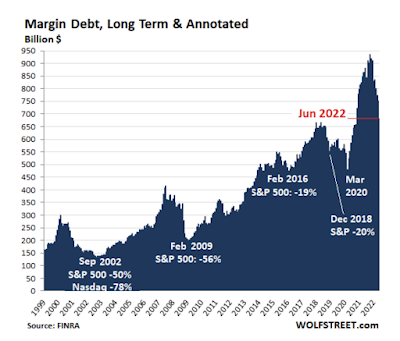
Declining margin, leverage, and big unwinds - A result of rising interest rates


Leverage is a core to the financial system as funds flow from those who have excess savings with unclear views to those that have a savings shortfall and strong beliefs. Finance is all about finds funds to give to those who want leverage. Leverage seeps into the financial system in places that are not always expected or closely watched. When the cost of borrowing increases, conviction goes down and the marginal view is cancelled. When leverage is taken out of the system, demand falls and prices must adjust.

There is a great deleveraging in equity markets that started when the Fed said they would end cheap money. At close to zero rates and negative real rates, borrow. When the cost of money increases, it is time to scale back bets. Margin debt has declined by a quarter of trillion dollars since the peak, that is money not entering the markets. Every time there has been a double digit fall in margin debt, there has been a subsequent fall. The decline in debt may not be the cause of the stock decline; however, markets are driven by feedback loops. Rising borrowing costs and falling valuation from lower present values all contribute to the same result, lower prices. The hawkish Fed should lead to further declines in margin debt and less equity buying demand. 

Tuesday, October 19, 2021

Deposits up and loans down - Is this a healthy bank environment?


C&I loans at banks are only 3% higher than before the pandemic and have fallen 20% from the peak levels in the second quarter of 2020. Banks are flush with deposits from Fed QE purchases, yet the money is not going to new loans. Banks can hold the excess reserves and get paid low rate, or they can hold longer-term Treasuries. They can also package loans and securitize them. Loans do not seem to be a high priority given the environment. 

The deposits at commercial banks have exploded and continue to grow. Deposits up and loans down; what does this tell us about bank lending health?


The commercial and industrial loans are likely a better indicator of smaller business that do not have access to capital markets. We have argued that we are in a supply-shocked environment, but these numbers suggest that business and banks do not see a bright future for profits and growth. Banks don't like the loan prospects and business are either not borrowing or getting the credit they need. This is a downside risk.

Sunday, August 22, 2021

Money, money everywhere but in the loan market


With the Fed still buying $120 billion in Treasuries and mortgages every month, short rates still close to zero and real rates solidly negative, the loan market should be exploding with firms and households borrowing to take on new projects and funding consumption. Banks should be willing to lend given the strong deposits and excess reserves. That is the assumption, yet reality is different. 

Reality is different because credit markets are different. Banks will ration credit not on solely on price but on standards for lending and expected risks. If perceived risks are high, the price of credit will not matter. Similarly, borrowing will be based on expected return from an investment project. The discount rate is relevant, but cash flows dominate. Similarly, households will take on more debt only if there is the perception that future income will improve. While central banks can change the cost of credit and the supply of money, these variables may not control behavior in the credit markets. The credit question is always forward looking for both parties. Will the creditor be paid interest and principal, and will the borrower generate enough to pay interest and principal? 

Sustained growth is driven by business and consumer confidence and not just low interest rates. Right now, business and consumer confidence are declining which creates an economic headwind.

Monday, July 26, 2021

Collateral shortage and reverse repo

The US is different from other financial markets because so much of financing is outside the banking system. Bank lending is more important in other countries. Capital markets are the driver of finance in the US which means there are special needs for collateral with lending and leverage.


The capital markets cannot work efficiently if there is a shortage of collateral regardless of how much excess reserves are in the banking system. The spike in reverse repo, while an overnight offset to the impact of QE as measured through changes in the Fed balance sheet, is a reaction to changes in the micro plumbing of financial markets. Recent increases in reverse repo have been a response to the elimination of SLR (Supplementary Leverage Ratio) relieve for banks, the drawdown of the TGA (Treasury General Account) at the Fed, actions to the debt ceiling statutory ceiling at the end of July. 

In general, structural changes cause changes in the demand and supply of deposits at banks. At times banks want to hold less deposits for regulatory reasons. This constraint by banks causes money to flow to other short-term investment like money funds. The overall flow to other parts of the financial system creates collateral shortages which generates rate stress. 

In the case of collateral shortages, rates can spike because there is inelastic demand for necessary collateral especially early in the day. If risk increases, flow to safe assets increases, or there is a price dislocation which creates the demand for collateral, the available safe assets are constrained even with the Fed balance sheet (QE) increasing. 

Investor should care about plumbing because disruptions in the most liquid market for safe assets, Treasuries, will create the perception market dislocations. Increased risk perception concerning collateral will generate a build-up for portfolio safety and risk-taking should diminish. Hence, we should see a portfolio rebalancing out of risk assets. A collateral repo disturbance will increase the desire for a safety reserve.  

Saturday, August 22, 2020

The complex relationship between banks and the Fed


The last financial crisis was focused on ensuring the integrity of the banking system to support the real economy. Massive liquidity and capital were given to banks to support lending and the real economy. In hindsight, there were missteps with the bail-out and the foundational view that some banks were too big to fail. An opportunity for restructuring was lost. Since the Financial Crisis, banks deposits are more concentrated and the surviving firms have done well without penalties for their excesses. 

The current crisis is different. There was the critical financial liquidity crisis in March, but there was no bank crisis. The Fed effectively managed the liquidity crisis with swift action and no shortage of liquidity, yet the current situation is now one of business solvency and getting a constrained economy growing. Money can relieve financial liquidity pressure, but it cannot remove constraints on aggregate demand and supply. Money can lower rates but not directly engage in lending and supporting business solvency.


The current path of monetary policy over time subverts the ability of the financial sector, banks, to provide effective lending. Lending has to be profitable. Banking needs capital and a return that will attract that capital. 

There are three policy effects that work against banks. We know that the effects are negative both from history and the current languid gains from banks. One, low nominal rates near zero hurts banks as yield spreads compress. Two, any policy that provides forward guidance or attempts to control or flatten the yield curve will only further hurt bank earnings. There is no gain from lending long and borrowing short. Three, a poor economy and little ability to generate earnings from spread and curve differences will only further tighten lending standards. Lower ROE from lower earnings and increased loan loss reserves will not allow banks to more aggressively lend.


The most recent survey of senior loan officers shows a significant tightening of lending standards. Deposits have grown but the money is only being used to purchase government debt at low rates. Given the low capital weighting for holding government debt, new deposits are not going to firms, small businesses, and consumers but for Treasury financing. Banks, at this time, have headwinds that will have both financial and real effects.

The big question is how the Fed will be supportive of banks and the financial system so financial firms are able to generate earnings that can be used to support lending. Without a profitable banking system, any recovery will be muted. This is the forward guidance that is currently necessary.

Wednesday, January 22, 2020

Financial Stability Board Report - The shadows of banking are big


The Financial Stability Board (FSB) just released their new study Global Monitoring Report on Non-Bank Financial Intermediation 2019 which includes data through 2018. It provides a comprehensive analysis of the "shadow banking" system now referred to as "non-bank financial intermediation" (NBFI) with a lot of details on the credit system outside banks. 
  • Shadow banking continues to grow and is critical part of global financial intermediation, albeit market share for non-bank financial intermediation has declined slightly.
  • The relevance of shadow banking differences greatly by country and region which makes monitoring or drawing inferences on global stability difficult.
  • Complexity within the credit markets is high and it is not easy to see where there are current critical risks. There are a number of credit function categories and maps for describing financial intermediation.
  • The FSB divides NBFI into five economic function categories: collective investment vehicles, lending entities based on short-term funding, financial intermediaries, credit creation facilities, and securitization.


Banking is still important but the financial intermediation in other forms and from other sources means that central banks have a hard time controlling rates, risks, and lending. The data shows that repo markets have increased in importance. The Fed may have thought there were enough excess reserves as of September, but in reality, the financial system is also driven by the flow of funds outside the banking system.

This stability report reinforces our ongoing theme that it is not the liquidity but the plumbing that is the potential problem area for finance. Bank capital has grown, and leverage has been controlled since the Financial Crisis, but shadow banking has continued. The regulatory rules of the game have also changed which impacts credit flows. 

Of course, this report tells us that the shadows are not as dark as before, but there are still a host of issues on the quality of lending, terms, and defaults that still are opaque. 

The next crisis issue will be similar to those in the past, a shortage of liquidity, the inability of borrowers and lenders to access cash in the margin, and contagion from not knowing whether capital will be repaid or who is creditworthy. It is not clear that buying Treasuries or just lowering rates will be able to solve these problems.    

Friday, December 6, 2019

Bank regulation getting better, but will it be enough?


Where is the next financial crisis going to come from? This issue is always on the minds of investors. While it come from the banking sector? 

There has been a significant increase and improvement in the regulation of banks in high income countries, but the supervision and oversight for EM banks is not at the same level. These banks do not have or meet the same capital, leverage, and regulatory requirements, so there is less buffer against any financial shock. Now, this risk differential between DM and EM has always been the case, but it suggests that EM financial institutions may still be more vulnerable than DM financial firms. (See Bank Regulation Supervision a Decade After the Global Financial Crisis Global Financial Development Report 2019/2020 World Bank.)

While there is a strong agreement that the post crisis financial regulation has reduced or mitigated transmission of international shocks, there is the view that more financial activities have moved into the shadows.


There has been improvement in regulatory capital to risk-weighted assets for high income OECD countries, but developing country capital to asset ratios have stayed relatively stable. 


Countries have been meeting different regulatory standards. The high income countries have just about all reached the Basel III regime while lower income countries are still governed by Basel I and Basel II. While this is not a danger, the sensitivity to any shock will differ across countries.

Although it is not directly related to bank regulation, bank concentration continues to rise. Larger banks have the infrastructure to improve risk management, but risks are also further concentrated. 
Bank riskiness, impaired loans and provisions before and after the crisis have all moved in the same direction. The data tell a mixed story. The bank z-scores are higher, but the loans to deposits ratio is lower. The nonperforming loan to gross loans and provisions to nonperforming loans are mixed. 

While there has been a rise in leverage and overall debt globally, the actual riskiness of the banking system has declined. Nevertheless, the dispersion of supervision and regulation should be a concern especially for investors who focus on EM markets. Additionally, the greatest fear should be that risks have moved into the shadows that are not regulated.

Friday, November 8, 2019

Senior Loan Officer Survey - No real change over the quarter

All the talk can be about what whether the Fed is lowering interest rates, but if credit conditions are getting tighter because banks are being more stringent on their approvals, then the intended effect will not occur. The price of credit is not the only mechanism for rationing the supply. The loan standards matter.

The Fed's senior loan officer survey shows that there is an overall neutral balance in standards, limited change in spread conditions, and weaker demand for loans. On balance, the survey suggests that there is limited change in credit availability conditions. If there was fear of an imminent recession, it is not showing up in these numbers.  

Monday, October 29, 2018

Rising interest rates on loans - Current numbers don't show a change in standards


The channels of monetary policy are more important for any investigation of the macro economy. This is one of the key lessons from the Financial Crisis.  Now that short-term rates are finally moving higher, the behavior of banks with respect to their lending activities becomes more critical. It is expected that as rates move higher, the demand for loans will be lower. Additionally, there may be a tightening of lending when rates move higher. 

How tight will lending become as rates rise? There is limited analysis on this question, but a Journal of Finance paper, "Bank Leverage and Monetary Policy's Risk-Taking Channel: Evidence from the United States" suggests the higher rates will take a bite out of riskier lending.


This is important because there is so much debt that will have to be refinanced at higher rates. There will be a day when debtors will need more money or have to rollover existing debt. They may know that the price paid for that debt will be higher, but the real question is whether the quantity will be available. Past research says there will be a day of reckoning; however, that day has not yet come. 

A review of domestic loan tightening standards suggests that at this point there is nothing wrong with the supply of credit.  There is no tightening. You can warn about credit, but any action on this warning may be early. Investors may avoid fixed income based on the the direction of rates, but right now, the risk of banks not providing credit as a reason to avoid seems to be limited.

Thursday, February 2, 2017

Banking and speculation - all a matter of opinion?


"When as a young and unknown man I started to be successful I was referred to as a gambler. My operations increased in scope. Then  I was a speculator. The sphere of my activities continued to expand and presently I was known as a banker. Actually I had been doing the same thing all the time."
 - attributed to Ernest Cassel by Bernard Baruch 

Banking is respectable speculation or at least it was up until the the Great Financial Crisis, so there is a good question of who should bear the risk of this activity. There is little question that shareholders should take this risk, but even under the current system there will be shifting to governments. The risks are increasing if rates are going higher and this may not be good for any bank stakeholders. The Fed, when it lowers rates, helps banks through reducing their cost of funds and increasing the value of their loan book and assets.

Now we are in a different period. Rates are headed higher with the cost of funds increasing and the value of loan books and fixed income assets declining. This calls for new speculation by banks as they adjust to this new tightening regime. How does the bank get out of the way of rising rates and keep the firm profitable? This form of speculation occurs even if it is called hedging by risk managers.

Make no mistake, this activity involves speculation through views on rates. This bank speculation is not a matter of opinion or perspective. Positions, in a lower margin environment, have to be taken. Banks are not usually fully hedged, so rising rates can have a negative effect, or it can offer new opportunities to increase loan rates while keeping a lid on deposit rates. Margins will change.

The euphoria of potential deregulation has driven the financials sector higher, but now there will be the hard work of determining which banks will be better at coping with potential rate increases.


Sunday, January 1, 2017

Divergence in bank performance between US and EU - so what?


The one take-away from the Great Financial Crisis has been the importance of financial intermediation, banking. When banking is disrupted, lending will not happen. There will be a cutback in credit which stalls the economy. Additionally, if capital is not available for banking, there will be a cap on lending especially if there is a constraint on leverage. Funding will become scarce. If bank capital falls, lending will be disrupted. This lending channel is amplified with the swings in the business cycle.

It does not matter whether the central bank is increasing the money supply, if financial intermediation is not occurring, there will not be economic growth. Of course, increasing money will force down interest rates, but the channels of finance need to be clear to allow the flow from lenders to borrowers. 

There is a large  difference between the US and EU financial services indices, XLF versus EUFN, this year with close to a 25% return gap. There is the drop from BREXIT, large gain from the US election, and the risk from Italian banking which explains much of the difference. Regardless of the corporate bond purchase program of the ECB, more lending is done through banks in Europe. Poor equity performance hurts bank intermediation. This will spill-over to the rest of the economy and suggests that growth differential between the US and Europe will not be closed.

Monday, October 17, 2016

The End of Alchemy - the real take-aways


I finished reading The End of Alchemy: Banking, the Global Economy and the Future of Money and came away with some useful but simple insights on the current state of finance by the author Melvyn King. This is not just another Financial Crisis book but the views of one of the thought leaders within the Bank of England during this critical time. It describes many of the current problems with banking today, but it really focuses thinking about the aftermath of the crisis into three areas, disequilibrium, radical uncertainty, and trust.
  •      Disequilibrium exists in the post-crisis financial world and monetary policy through lower rates may not be enough to eliminate the problem. In fact, low rates may create new disequilibriums. Without thoughtful policy, economic growth and bank safety may be stuck in a poor state. There may be needed shock policy to get us to a new stable equilibrium state.
  •       Radical uncertainty continues to exist and stops investment and consumer decisions from being made. Radical uncertainty is further fostered when new policies are tried which are disruptive to past policy behavior. Strong growth in investments cannot be expected in a highly uncertainty environment.
  •       Trust in the current financial world is paramount to generating a stable economic and financial environment. Changing levels of trust leads to bank runs, cautious investment behavior, and poor response to policy initiatives. In a highly levered financial world, trust is critically important to a smooth and effective financial system.

Of course, there is much more to this book, but the three themes of disequilibrium, uncertainty, and trusts are drivers that pervade all of the other think gin about policy and the economic response of the markets, consumers, and investors. 

In this world, why would we expect that the same forms of fundamental thinking would work for investors? Following market prices would not seem irrational in this world.