Saturday, July 6, 2024

Every Man a Speculator - A fun read on financial history


Steve Fraser's Every Man A speculator: A History of Wall Street in American Life is a fun book that provides color about the characters that have driven US financial history. Rogues may be a better word than characters, but it gives the reader a deep history about the culture and people that populated Wall Street throughout our history. Fraser is a great writer, but this history could have been shorter and more focused if it wants to reach the average reader.  It is supposed to be about American life, but the focus is more directed to personalities and not about how Wall Street impacted cultural thinking. The life component is there just not always front and center. Nevertheless, the writing is memorable:

"In 1929, the raucous staccato of ten thousand ticker-tape machines had provided the jazzy accompaniment to Wall Street's fandango. Only two thousand machines were left by 1941, their rhythms slowed as the street grew quiet, almost inaudible to the American ear." 

On the corporate raiders of the 80's 

 "...at least they worked like demons to get it, putting in inhuman hours, beginning their days at four in the morning, ending them at midnight. For them, hard work, an American sacrament, was an aphrodisiac, a living reproach to the stereotypical Wall Street banker whose day began at ten and ended at three with an intermission for a three-martini, two-hour lunch. "

Friday, July 5, 2024

Keep it simple with realized volatility forecasts


One of the key risk management problems is forecasting volatility. A key issue for any option trader is forecasting volatility. You cannot do either without good volatility forecasts. So how do you get good forecasts? The Machine Learning (ML) crowd will say that you should use the latest non-linear techniques to improve forecasts. This view assumes that more complexity is better than a simple model, yet this is an assumption that should be testable. 

In the paper, "Forecasting realized volatility: Does anything beat linear models?", the authors compare different tests on the quality of linear and non-linear ML models for forecasting realized volatility. They conclude that heterogeneous autoregressive (HAR) models should remain as the workhorse for forecasting volatility.  The HAR models generate a volatility forecast using past volatility across different horizons. The ML techniques include neural networks as well as tree-based methods. 

They find that adding predictors will improve the out-of-sample forecasts for short-term forecasts, but there is no evidence that ML models can outperform the linear models. The models are tested against MSE, one-day ahead VaR, and realized utility. Simple works well and forecasting realized volatility does not need the added work from ML procedures.


Volatility targetting is trend following for equities


Volatility targeting outperforms a buy and hold strategy, but why? Volatility targeting is the process of adjusting risk exposure or leverage to set a specific volatility level. Usually, managers set the leverage and allow the volatility to move.  

Volatility targeting works because there is a negative correlation between return direction and volatility which has been called the leverage effect. Volatility targeting will be negatively related to the magnitude of recent returns. Given this relationship, we can say that volatility targeting has a trend following effect. The relationship between volatility targeting and trend-following was explored more closely in recent research paper, see "Volatility Targeting is Trendy: How Trend Following Explains alpha in Volatility-Managed Strategies". The leverage effect is not present with bonds, commodity and currencies.  If you control for trend-following the alpha from volatility targeting will decline by about 2/3rds when tested against a portfolio of 14 stock indices. The volatility targeting link to trend-following does not occur with other asset classes. 


Mixing trendfollowing with global macro - A good combination


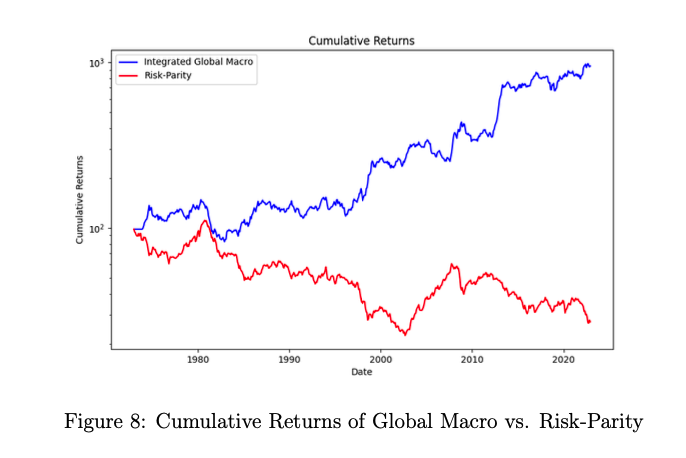
The combination of trend-following and global macro seems to have significant merit. These two strategies complement each other because their signal generation is different.  The work of Aidan Vyas in "Evaluating the Performance of Systematic Trend-following and Global Macro Strategies" develops two strategies and the shows their distinctions and areas for benefit. 

Vyas looks at a broad set of countries and asset classes across stock indices, bonds, currencies and commodities and employs GDP growth, inflation, interest rate as a policy indicator, and real exchange rates as key economic indicators within a risk parity framework. Trend signals are based on risk -adjusted cumulative return for three different timeframes (1, 3, and 12 months). The global macro signals are based on the trends in the global macro indicators.

Global macro alone is not much better than a risk parity, but if you add trend and macro, you get a better Sharpe ratio and lower volatility. The macro approach is simple, but it does suggest that diversification of strategies works.