Monday, June 6, 2022

Data and lawlessness - think in frequency and when in doubt, think random


In his well-written book, Chancing It - The laws of chance and how they can work for you, Robert Matthews explains well the basics laws of chance and probability, but he also spends time describing what he calls the principles of lawlessness. It is a nice device to remember some important statistical concepts. 

The first law of lawlessness - do not look at events look at the frequency of events. Every number should be looked at in context, the context of likelihood. Ask the simple question - what is normal and what is abnormal. Risk management is all about getting the frequency right. 

The second law of lawlessness - When trying to understand random events don't assume they are independent and don't assume that correlated events will stay that way. Live would be so simple if the events were independent. The probability of A and B occurring is just the product of the individual probabilities. However, if you know the correlation of two variables, do not assume that this correlation will stay the same. Correlations change and may be related to a third variable.

The third law of lawlessness - randomness does not ultimately have patterns; but in the short-run there can be regularity. When in doubt, go with random. You may think you see a pattern in the short run, but that does not mean the pattern will continue, nor does it say that a time series is non-random. A random series does not mean-revert. A series of heads does not mean the next flip is more likely a tail, yet in the long run the frequency of a tail is .5.

Be cautious of any number and any count. A small sample will tell a different story from a large sample and the actual likelihood may be different from any data collected. When in doubt, trust randomness. 


Sunday, June 5, 2022

The fiscal policy bet that led to more inflation


US inflation is higher than other countries in the OECD. The difference is significant and started last year before the Ukraine War. We have been running the economy hot even before the pandemic based on relative inflation. We are now seeing he results of these policies. 

Charts are from a good short research piece from the San Francisco Fed, "Why is US inflation higher than in other countries?" 

At the same time, the real disposable income has jumped to higher levels than other OECD countries. Disposable income was similar to other OECD countries before the pandemic. US fiscal policy pushed disposable income higher versus the rest of the developed world. The fiscal policy spikes are now normalizing. 

If the fiscal support was not present inflation in the US would be 3 percent lower than current levels which would put the US back in the OECD range. The US made a bet to aggressively expand fiscal policy to maintain the real economy during the pandemic. It may have been assumed that inflation would be higher given this stimulus, but since the US was just below the 2% target, the Fed and US government were willing to accept the risk. The oil and logistic supply shocks as well as the war were not fully expected. It was a policy bet and it has not worked out with respect to inflation. It should be owned, but the investment question is what will now happen.

First, monetary policy is becoming restrictive. The Fed may be moving faster than other central banks, for example, the ECB.  Second, there is no BBB bill that is pending or has been approved so the fiscal policy has become more restrictive and consistent with other countries. Hence, we should see inflation move back to OECD averages. Inflation should normalize at a level lower than current headlines. What is unclear is the timing. It is easy to argue for inflation mean reversion, yet it may not come until the end of the year and that will be at the price of lower aggregate demand. 


Saturday, June 4, 2022

Sector and country equity performance mixed for May


Large dispersion in sector performance with energy sector still dominating markets. Large declines were seen in consumer discretionary (XLY) and real estate (XLRE). These declines should be expected in a rising rate and threat of recession environment. 


Surprisingly, there is large dispersion in country equity performance given the discussions concerning global inflation and stagnation. Several European countries had gains over 5% for May. The two biggest outliers for 2022 are Mexico (EWW) and Brazil (EWZ). 


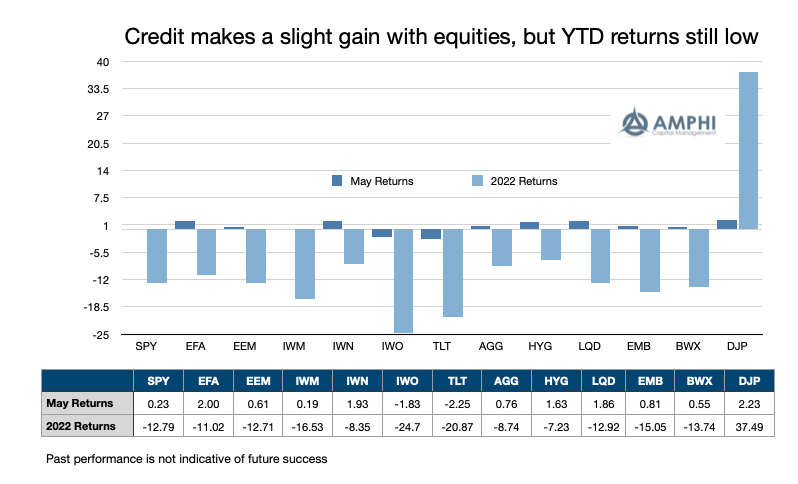
May performance only a trend slowdown from stagflation theme


May performance did not change the trend in asset prices. The global macro trends are still in place and the stagnation story still dominates thinking. There will be volatility caused by the switching between inflation or recession as the dominant theme. Higher inflation hits fixed income hard, but equities have not been immune from price increases from input costs. Higher recession fears cause a switch to fixed income from equities. The swings in stagflation thinking will impact views on monetary policy which also feedback to equity and bond markets.


The clear loser has been growth stocks which have been deeply affected by changes in the discount rate. Value stocks have served as an investment area of protection. Surprisingly, the mid cap and small cap indices have done slightly better than large caps. Clearly, the large cap growth and tech sectors have been affected by rising rates. 

With improvement in equities, there has been an improvement in credit markets. Long duration Treasuries were hurt by the continued talk of higher rates from the Fed. It is notable that TLT, BWX, and EMB, the core sovereign bond indices have all underperformed the major stock indices.