Saturday, November 12, 2011

Refining driving dip in oil inventory

When oil is cheap relative to end distillate products, refining margins will increase. If you can get cheap oil, you will run flat out and try and make as much money as possible. This is what has happened in the Midwest. The result is a fall in Cushing, OK inventory. NYMEX crude has moved from contango to backwardation and the spread between NYMEX and Brent has collapsed. 

Refiners who use North Sea oil or OPEC oil are not running at high cap utilization rates and have lower margins. The refining economics are simple, but will not last as inventories get tighter and prices increase.
Keystone XL pipeline - the future of oil dependency

The Keystone XL pipeline decision has been placed on hold until the end of next year. The will limit the amount of oil that can come from the vast Canadian tar sands reserves. We will continue to be dependent on distant oil. Of course, there are environmental issues which have to be addressed but an energy policy has to be base don multiple sources of oil. 

Canadian tar sands are expensive oil with the break-even costs at about $60 per barrel. Those will go up once the easy sands near the surface are used, but at current prices this is a viable and useful source of energy. Not building the pipeline will place stress on the global oil infrastructure. Canada now has the second largest reserves next to Saudi Arabia. It is a natural and a likely better source relative to deep off-shore oil

Friday, November 4, 2011

What happens when wheat prices rise?


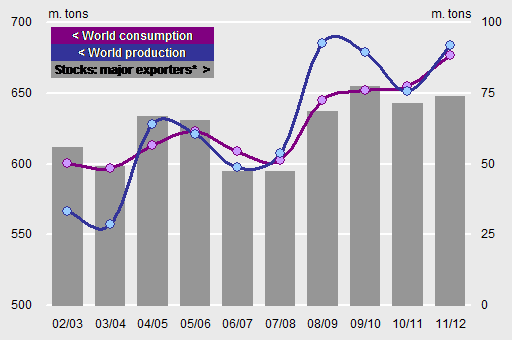
Markets respond to incentives. Higher prices mean rationing on the demand side. Higher prices will cause more supply to be produced. What happens next? prices fall form the over supply. Look at the wheat market. Prices are the lowest in years and have declined form over $10 / bu in March to current prices of $6.36 /bu.

Stocks are rising after what seemed like a crisis last year. Production is outstripping consumption so the price of wheat has come down to a new equilibrium level.

See International Grains Council

Draghi takes action

Mario Draghi, the new ECB president, has decided to take action almost immediately with a 25 bops cut in the in the ECB benchmark rate to 1.25 percent. He also decided not to ramp up the bond buying program of the ECB. He said the program was supposed to be temporary.

Draghi has now shown that he can be a man of action although 25 bps in a crisis is not overwhelming. He is also a traditionalists by lowering rates instead of buying bonds. He also sounds like a president who will be interested n growth as well as inflation. He will unlikely be a large departure from now former ECB president Trichet. He seems to be a pragmatist who will not be pulled into the fiscal problems of the EU unless absolutely necessary.